Cowboy Atlantic
A mystery at the library in Baia Mare

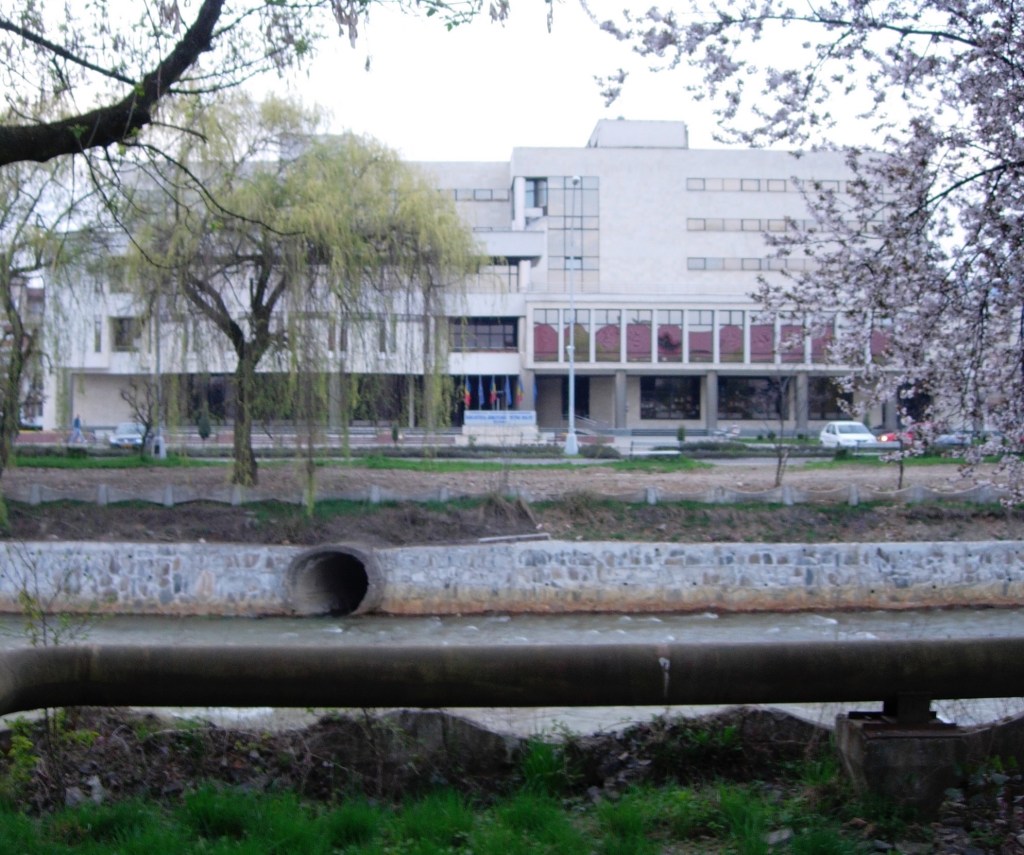

On a mild Good Friday, unconcerned by intricacies of history, a pretty companion and I strolled along the leafy streets of Nagybánya (Baia Mare).1 An abused brown river gushed from the deforested hills that cradled the strategic town along Romania’s northwest boundary. We had honored the fast so far, purposefully hungry. Anyway, I was distracted by low-hanging fruit of another sort, a stunt and a hunch, matched with a dose of fuck-it-why-not.
“Such a long shot,” Lia said.
She shrugged, then pushed through the black doors of the gray communist slab that was the county library. Next door, another monolith, the sooty white Carpathia Hotel, was decorated with cement horns and reputedly the home of a well-stocked sauna.
The muddy grumbling of the Săsar River muted as we entered.
The receptionist, hair lofty in a headband, body in silver dungarees, insisted on a photo for a library card before continuing. I wasn’t planning on visiting that long, but my goofy smile made a cute memento. She then marched us to the librarian’s office.
Ioana wore a white dress splashed with inky spots.
She listened to my request as Lia translated: “He’s a researcher from America. Do you have any records about the cowboy circus of Buffalo Bill on approximately July 17, 1906?”
The request was too abrupt, too precise for this sturdy woman in a flowing dress. I shouldn’t turn up on a Friday that even Orthodox Romanians regard as half-off, at least in Transylvania.
“You’re too late and on the wrong side of history,” Ioana relayed. “We haven’t any newspapers from that period. Or any memorabilia. We became the county seat of Maramureș after 1919, and everything was tossed into the streets and set alight. Go to Sighet and look there. That was the county seat in 1906.”
I hadn’t expected any lead, and this confirmed my suspicions: Maramureș County was one-third of its original size, divvied up among its neighbors; any materials from a meticulous Habsburg record had been removed to Budapest well before the signing of the despised Treaty of Versailles at Chateau Trianon in 1920.
“Call Echim in Sighet,” she said emphatically. “He knows everything. He’s got the newspapers.”
All I sought was confirmation that Bill’s magical show had stood here, if only for one day of the twentieth century, enough time to impress the town that America was both rich and powerful, both refuge and paradise.
While she jotted down Echim’s information, Ioana sparked my interest with a piece of intrigue, an account2 of Maramureș shepherds who migrated to Montana in 1907 and returned with their profits by 1917.
Had the shepherds seen the dayglo handbills from Buffalo Bill’s Szatmár or Sighet shows in 1906 and come to America thereafter? Was it likely? Montana and Maramureș share green sweeping hills that engage with high mountains and a labyrinth of woods and meadows oozing with game. They share merry mountain songs as well as dirges and spaces where the land is harvested for meat, honey, fur, gold, oil and timber.
Later, a modem connection that might as well been puffs of smoke disgorged a request for an appointment for the first available day after Easter.
Lia’s tiny flat was awash with her mother’s culinary preparations: lamb’s head and sorrel soup, offal-stuffed lamb, braised lamb liver, roasted lamb legs, polished radishes, sparky onions, pyramids of stained eggs, tinctures of schnapps and village wine, snack cabins hewn from homemade cheese straws, and plates of homemade cakes with names like harlequin, wasps’ nests and Linzer.
Put off by the gluttony, Lia disappeared to visit her aunt. I pretended to struggle with the food. I mocked a protest and winked, “Not one morsel more,” while Lia’s mother buzzed around.
Bursting, I excused myself from the cramped flat and wandered to the center. I photographed the earthy pastels of the old gates around the plaza. Not far, behind city hall, I found a bowling alley, next to a run-down cinema. Entertainment and culture seemed to have lost its luster for the clump of people drinking wine from a plastic carafe, gleefully in despair on the broken steps outside.
There I imagined who might have been that ephemeral Bill who traveled here a century ago. Like any man, at some point in every day he felt like a loser, even when life was grand.
Adrift
A somber Bill in Habsburg

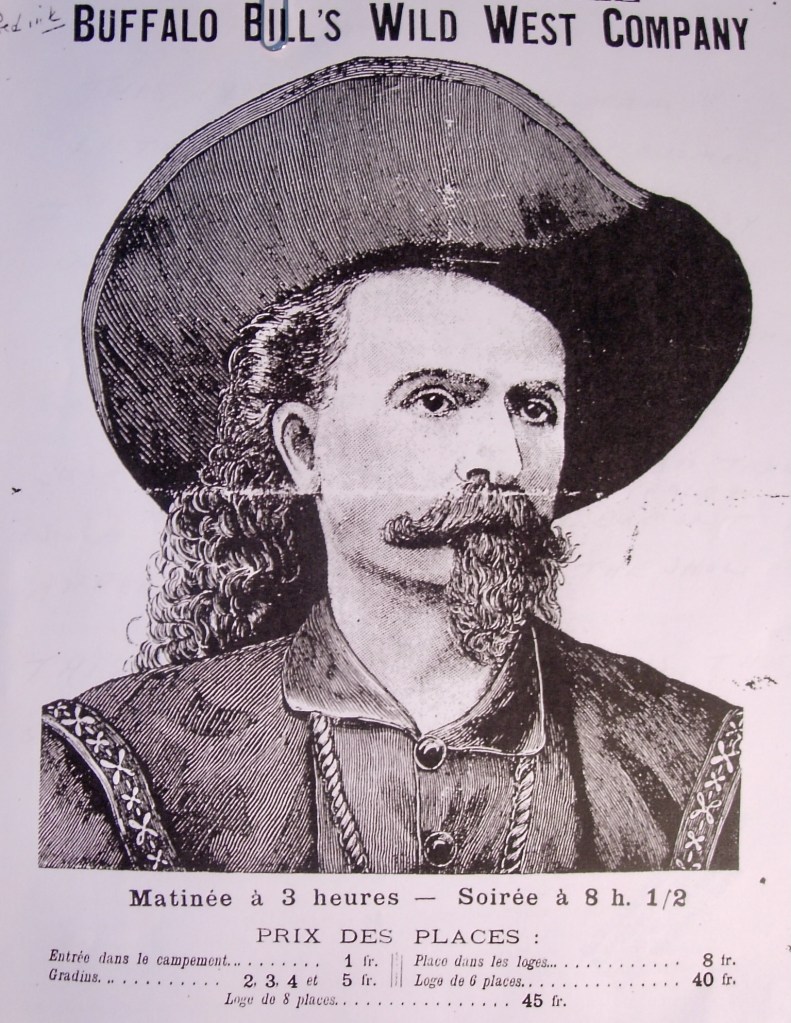
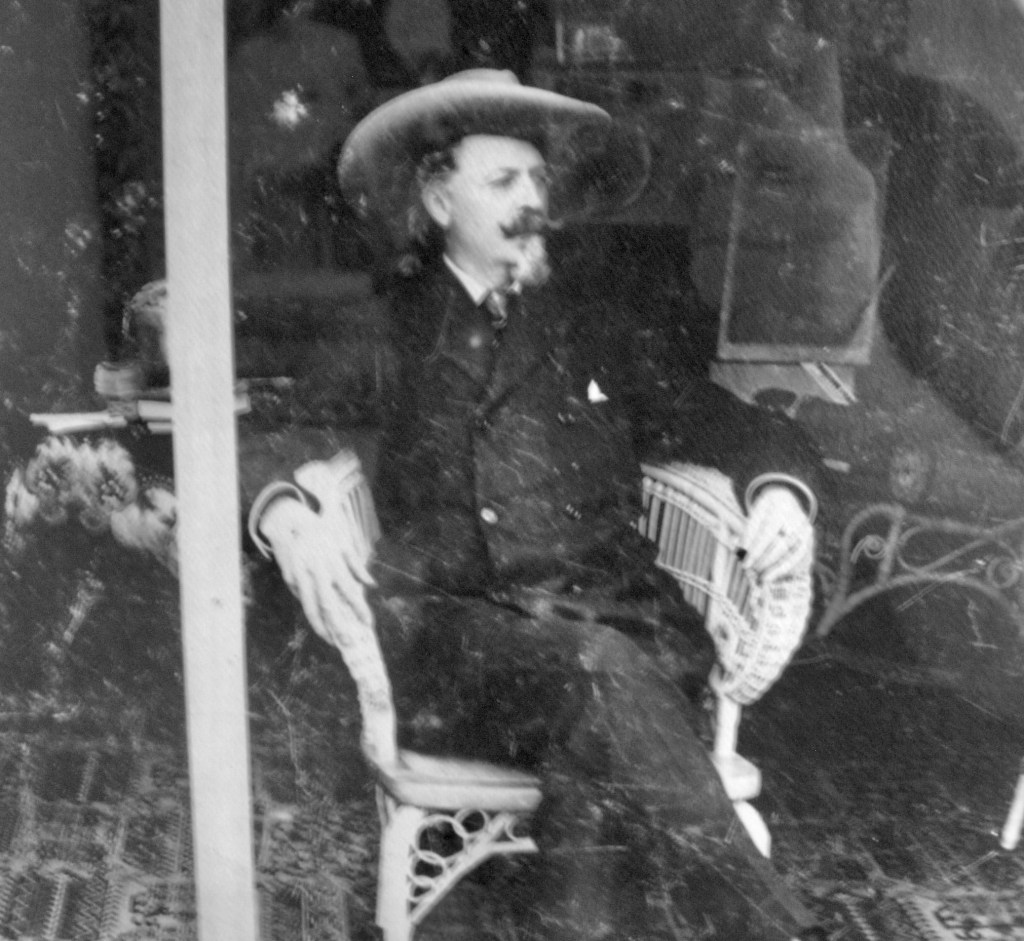
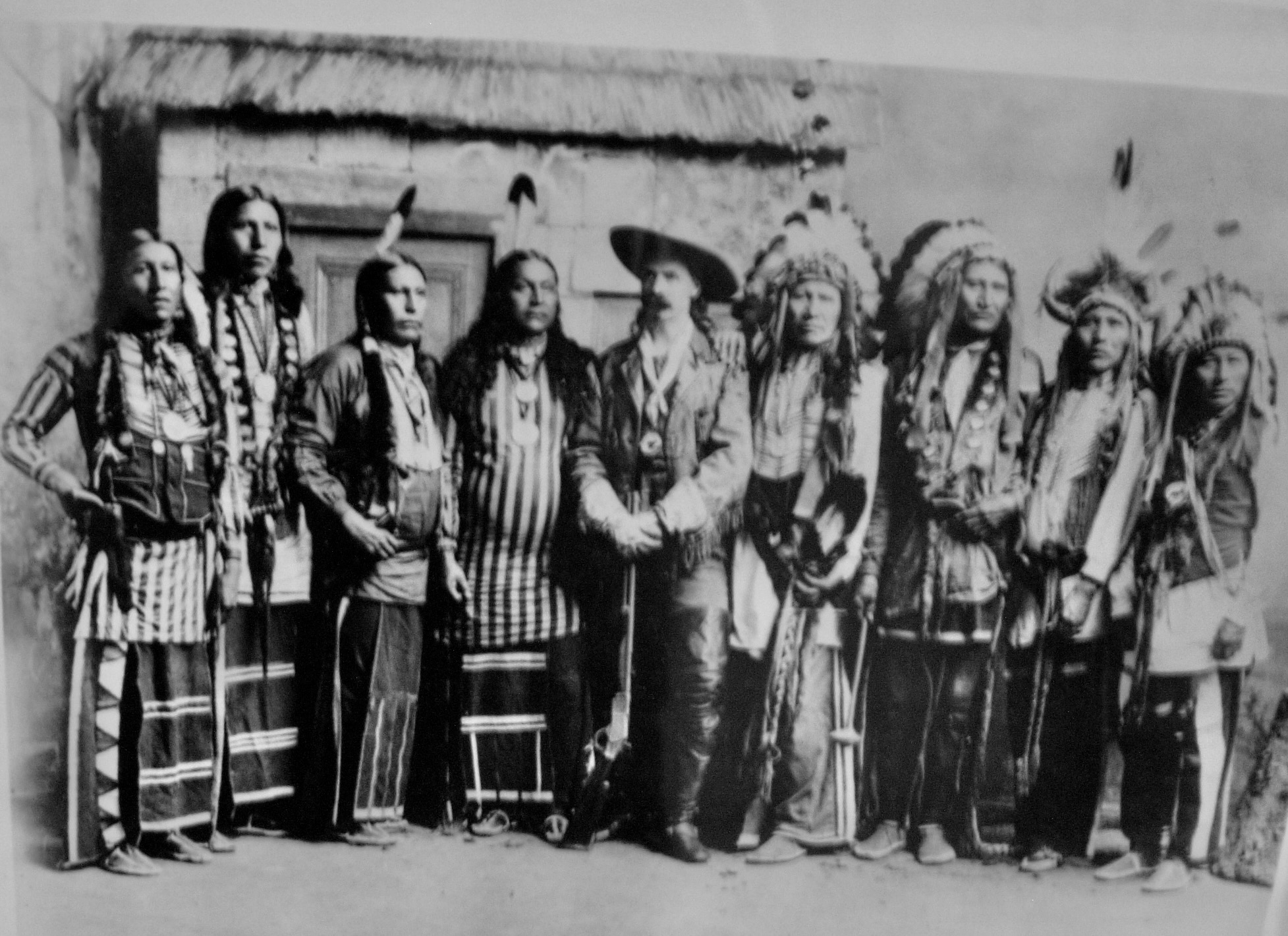
The tents went up in the morning. Three trains were parked alongside the lot. Bill and the dignitaries, the actors and performers, the animals and the hands.
He was hungover during the matinee, which was for kids anyway.
Bill parked in a café for the afternoon lull, drank under a parasol, flirted then bothered a cute customer, dispatched a boy for fry bread – popular with the Show Indians too – and improved his mood for the evening show.
All he had to do was mount up, ride out under the lights and listen to the roar.
The European towns surprised him, brimming with artisans who were missed sorely in frontier towns. Tailors, seamstresses, tinkers, smiths. Merchants with their stores dispensing fine cloth and oriental luxury at the ragged terminus of the Silk Road. Still the rope wasn’t the same and neither were the hats. They didn’t treat their cattle the same either. Remote villages, powered by water and wind, felt as old as civilization itself. And their fruit brandy was crackerjack. Yet he noticed they were soft, bowed and oppressed and he offered something wilder – progress, destiny, the test of civilizations, then men – freedom
He needed these people back home – he’d raised a town of cob, sod and lumber and watched it fold – and his agents littered the route with handbills for Cunard passage from Trieste or Odessa to New York. Afterall, he was handpicked as America’s foremost cultural diplomat to dispel the reputation that the United States was no more than bandits and brutes.
No, he was as modern as they came: men weren’t savages and women weren’t the lesser sex, at least that’s what he concluded when he was bent in half after days of snouts – any excuse to revive his brio.
The kids looked at him the same stunned way, like a giant among guides, part cowboy, part native. True, at 6’4”, his face powdered red and a feather akimbo at times, aloft on horseback, he appeared to be a grand specimen, albeit bedraggled in places. He had been kicked from place to place like a flat ball at this stage, one of his lungs black, topped with buffalo fur and prairie dust, the other ivory, poured from candle wax and perfume. Bill was alive because had unfinished business, wages and women moving through his morbid hands like mice. He’d always relied on two, two horses, two kids, two women, when the number should have been three, a wager like a kerchief that has more uses than a hat.
Sigmund had advised him in Vienna what he needed to survive, his wit, spirit and soul, where he would dive from home to infinity, yes in the east, like at home fearing to cross on the first of many mountain divides. Why forgive when he could accept? He hugged the alpine heights, stayed up top and away from the bottom, where he felt distracted, impatient and low.
The men parked their animals and transport when the day was done, market and milking over, work and money collected, mines belching out ore and men, and they gathered in the saloons, sawdust floors and blocks of ice on the bars. Some were building a reservoir, they said, and a smelter and mills. They erupted from the gravel and mud roads and ten city gates into the main square, hailed one another at the roundabouts, cursed when they had to walk further than necessary among monuments to poets and figures honoring the monopoly of humankind.
He laughed himself into his buckskins. The audience never knew performers were neither laborers nor slaves, but part owners, meaning they only got paid after he did.
The wind upped with the setting sun and whispers blew the ringlets of his wig, falling that much more spectacularly at home in the head-high grass. The folk, instead of coming from everywhere, they came from one place, rooted, advantaged, exchanging grafts and seeds, kith and kin, as much as he hadn’t been home, some amorphous resting place where he was troubled by his estranged wife’s nagging. Scout’s Rest was Luiza’s, and she was running it into the ground however she liked.
It’s hers, he concluded again, shaking his head.
She’d underestimated him when he gave it up. He was savvy and she thought him an imposter, unconvinced by his every elaboration. She hadn’t liked that patch of glorious land when she saw it and now it was hers. He sickened at the irony. He spent Easter weeks in Rome and then the Pentecost in Budapest. By October he could leave Europe and by Christmas he was home, the pine bar in New York City, his pasture Central Park, glassed up on stage, on show in Staten Island or Erasmus, he couldn’t figure without looking at the route book.
Never Accidental, Never Serendipity
A clue in Cody
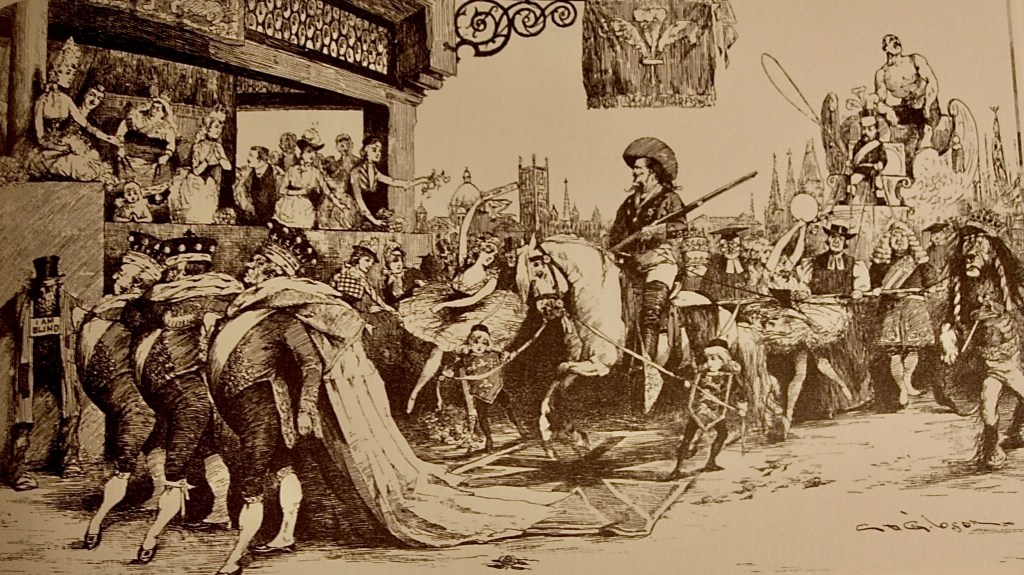

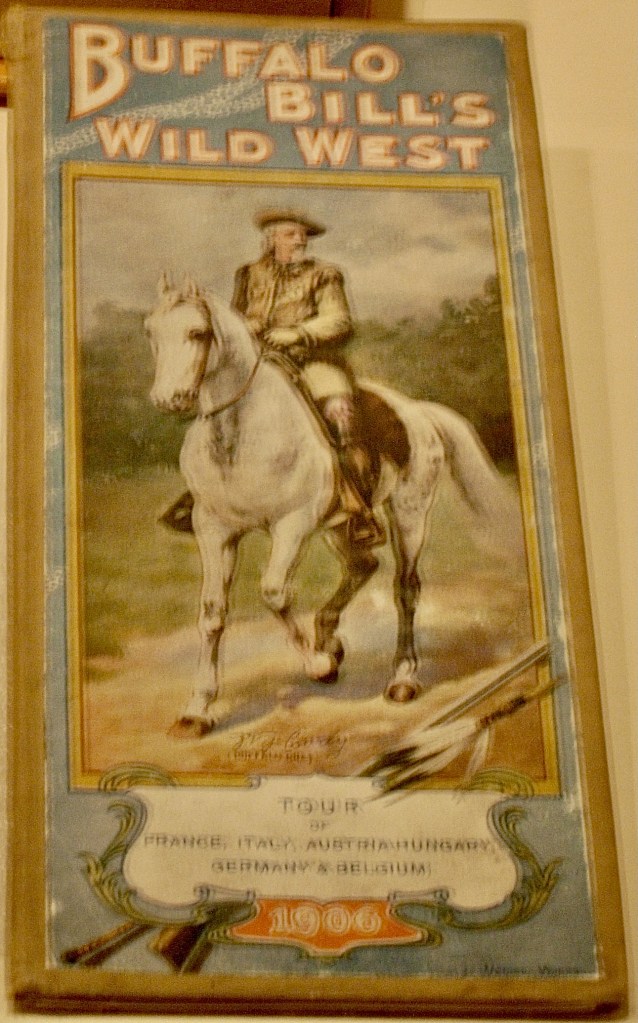
This search was purposeful and orchestrated once I saw what I needed. I was back in Goshen grasping for anything to occupy my mind. I couldn’t gut a ranch house of family relics all summer long, dragging heirlooms, crockery and junk out into the prairie for the auctioneer, without a break.
To alleviate the job, I sought out John, a salty character writing Western pulp fiction sold at truck stops across America to this day; he hid out teaching English at Goshen Community College when not hunting on horseback. Although not a reenactor, John enjoyed observing some of the kinks of the Western lifestyle, and he asked me over a Dos Equis if I wanted to drop in on a writers’ conference on all matters West in Cody.
“Sounds cool and offbeat, John,” I said. “And it’s only seven hours away.”
Some days later I caught a ride together with John and his family; they seemed unimpressed by the adamantine canyons peeling off the Bighorns on the way to the southern gateway to Yellowstone.
“Some of the conference members have trouble separating what’s fantasy from what’s reality,” he said. “It’s a little unnerving when you’re sitting next to a guy who thinks he’s Wild Bill Hickok.”
He chuckled at the thought, shaking his head, nudging his hat.
Soon I was roaming through a cowboy agenda punctuated by handshakes, whisky, cigars, steaks, poker and the crackle of mock gunfights outside the motel.
The conference was a hoot, but I needed to pause from all the bold talk of heroes and villains who dwarfed the everyday characters and cultures fatted in the underbelly of the discourse on America’s West. I sobered up enough to nose around the Cody Museum, sarcophagus to the legend and keeper of his memory and memorabilia. The collection was not without controversy regarding its blood trophies taken from the First Nations. The museum was trying to catch up with the echo chamber of America’s cultural debates, sensitize itself to the trauma of exhibiting guns that killed so many tribes and nations, but that attempt was muted by a gung-ho board and the sheer weight of tribute to William Frederick Cody who’d led the extermination of buffalo and therefore won his name.
I perused cases of uniforms, guns and equipment, studied dioramas and mannequins, read letter excerpts and ephemera, sifted through the errata of a man and his show that spanned the birth of American exceptionalism. They’d tried to present the multicultural aspect to his roaring international Rough Rider cast in showbusiness, his rehabilitation of Native Americans who had been consigned to the dumpster of history, and his role as America’s first cultural ambassador touring America and Europe. None of those superlatives could cover up his role in the body count to win the West.
One item leapt out at me that afternoon of told and untold.
There, lodged in a display framing his European career, I spotted the unmistakable umlauts and diacritic marks of the Hungarian language.
How could that be?
Had Bill gone to Budapest?
Not in my wildest dreams.
Yet it was undeniable: a souvenir route book from the Habsburg tour of 1906, Bill’s summer farewell to the breadth of Europe. Yes, it had been translated into Hungarian and clearly displayed the date: July 4, 1906, American Independence Day, which could only mean that Bill had toured my adopted home of Hungary and its neighbors if history was to be believed.
This unexpected clue inflated in significance by the second and almost seemed to account for why I’d drifted here, wherever that here was, a home somewhere between continents and oceans, paper and mind, past earth and present sky. Suddenly, there was a lot to investigate and many more questions to ask back in Europe. Only later, when I had proof this ephemera wasn’t a token glimpse or mirage, would I return to see what of Bill wasn’t on display.
To me it seemed Bill was as alive as Elvis, with all his flaws, in all his glory, synecdoche and totem for America.
Red Hand
Bill appears on family land


Bill rolls the truck to a halt next to the battered homestead filled with dry manure and a lonely chewed up mattress. Brittle elms. Water tank’s empty. Weeds. He edges through the barbwire and stomps across the field, his scabby boots kicking at the tufts of prairie grass and cactus. Not his place but near enough. He’s risked walking in and gambles a feisty old rancher won’t turn up for his steers or shoot crooked imagining he’s rustling cattle or staking uranium claims.
Bill walks toward the hills dotted with rock and cedars, dark green like yeoman. A hump shades the entrance to the canyon. There’s a waterhole and the wind has blown the blond sand away to reveal some darker black scarred earth the color of fire. Scattered with chips of flint and chert.
Water has seeped here into the prairie for millennia. He’d want a drink too if he were that old. Some days it feels like it.
The house is hidden by a fold in the earth. The valley opens in front of him, his feet wedged in the ruts of the jeep track.
Bill’s killing time, waiting to combine corn on his irrigated land. Still not dry thanks to a funny autumn, and no hard frost, he thinks. Shouldn’t be too long once Bill gets the signal that the shucks are dry enough. The boys’ll harvest 24 hours a day under klieg lights. Shame that the corn will be brewed into ethanol under the primitive sky.
The geese and cranes have been gliding over like an orchestra of brass and woodwinds making harmony. Bill grabs the scuffed field glasses and studies the creek. Wild turkeys are the game he’s most interested in. They hover along far out in the prairie until they come for water, and he might bag one. A fantastic shot, maybe he’ll be sober enough to shoot a black hen fat like a bauble.
Bill heads to the cave at Wildcat Canyon. The wind nearly steals his heart, it’s blowing so evil and hard. Inside the cave under the lip of the canyon his name is carved alongside the date. He returns 52 years, one day, and one hour later to the exact same spot where he had carved his name along with three other boys, Bob, Ray and Kyle. On the wall opposite rests a bright red hand, an ochre petroglyph, the marker for an ancient burial site, a signature, distorted and made huge, rough and prehistoric, a language. A fine place to hunker down and hunt, the cave big enough to hold a fire, a tongue of broken rock reaching from the bright entrance down to its dark floor.
He shakes his head as if to escape any blame from the land. “Sorry, I didn’t write it,” he says.
He guesses that must be why he’s in Wyoming at the edges of old territory of Mexico. Bill corrects himself, knowing he shouldn’t sum up that controversy to people round here, that there’s a contiguous history flowing along the Sierras and Rockies, that it’s the same conquest no matter if you’re Montezuma, Pancho Villa, Geronimo or Red Cloud.
Powered by his thoughts and desires, he skips visiting the farm and drives into Nebraska that night, through the towns of Mitchell and Morrill to the municipal twins of Scottsbluff Gering. The liquor store noticeboard suggests some entertainment is on tap, and he lands at a Mexican conjunto night, the rowdy band made of accordion, trap drums, singer, guitar, washtub bass, the audience drafted from the slaughterhouses in town. He doesn’t want to slurp back too much because he’ll weave along the corridor to Wyoming where too many people eject anyway. He loves dancing with senorita and senora alike, rotund like popsicles, hollering in his fucked Spanish, migrating to mezcal. Twenty years ago it was a dirty word to be a Mexican in Scottsbluff.
Not anymore. They got pride.
Ahh, it’s good being here, Bill thinks. Uncrowded. Doesn’t rain at all. But could be cold or windy, in a way that would yank your teeth from your gums.
People think it’s a flyover state but they’re wrong. It’s America’s Siberia, full of resources, prisons and bears. And if they’re short on rations, they can drive to Walmart. If they need company, they can hang at the town bowling alley with a fair share of end-of-roaders, deadenders, lunatics and oddballs who make life interesting in a mad, paranoid, armed way, so long as he avoids direct eye contact.
Bill feels better with the idea of the cave, huddling under the talisman of the red hand caressing the rock face. His breath collecting around his head, it felt better than the museum of objects and memorabilia which overstated so much of his legend. He couldn’t stand the place as much fun as it was to remember as time shifted through his fingers.
Marmot Island
More clues in Sighetu Marmației




The Easter gorging had been performed, the lambs and cakes consumed and now the mountains beckoned.
The mood blackened when Lia announced that her brother had a crackling smoky tumor so large that one lung had to go.
I was despondent at the news. Like so many ignored in the abject poverty of the transition, he was collateral damage of a successfully failing system. He survived fixing TVs and drinking meths. Cash handouts from family and friends went to rotten firewood and spongy bread. Pleas to re-train were met with indignation. He even may have relished being a martyr, the tumor his triumph, his auxiliaries not Dismas or Gesmas but Brenner and Eastwood, his attitude as fierce as any gunfighter making order before imminent death.
I itched to exit the family drama and get out of town, and Bill was a convenient excuse.
Echim was waiting.
The company vehicle of Transport Ruta 66 pulled alongside our stop. The minibus bubbled with teenage girls, who were amused by us, far too eclectic and western in our dress. We assumed our seats, the bus bucking past the gold mines that made Nagybánya tick.
Prefabricated housing had been dropped near the pits to accommodate the miners, and trees now greened the area, undeterred by a combination of cyanide-laced slurry and smelter fumes. Bursts of color were a testament flagging the past: in the upheaval postwar states had to house their people who had been displaced by forced population exchanges as the Allies portioned the map; states had to provide something, no matter how basic. Here, out of range of the victors, communism was marketed as the way out. If they once had sold revolution, now they sold utopia.3 Panels were glued together like ideology, complete with schools, co-ops and Mineral Bars, for drinking was a patriot’s opportunity to loosen up.
The switchbacks curled through beech and larch forests dashed with moss, sparkling with spring. The bus yawned past the ski area of blank, bald runs, coming to a stop at the cabins on the summit. The villages dwelled deeper down. Chartreuse oxen tugged lumber wagons as we jogged on. A pause to let off young women in jeans and cropped jackets, jumping down confidently onto the land. The pretty hills hosted gloomy wooden churches of Budfalva (Budești) and Felsőkálinfalva (Călinești), their sides stenciled with horrific accounts of Biblical ruin.
The road busied at the approach to Sighetu Marmatiei, the birthplace of Elie Wiesel and Amos Manor, a founder of Shin Bet, along with a handful of instrumental organizers of Zionism and the Teitelbaums, the glamour of Goldwyn Mayer and the tax-free kingdom of the Khazars. Not far from a geographic center of Europe – notorious for its decommissioned prison, the end for many counterrevolutionary, a bloody tangent of history commemorated as the Memorial of Victims of Communism and of Resistance – Sighet is the laser focus of this historical footnote, host to Buffalo Bill’s tour on July 26, 1906 looping its way northeast, when three trains pulled into the station, eight lines of siding, the site on now which chugged with scruffy local transport.
Lia and I boiled in the sun and shook in the shade in Sighet. The place seemed to hardly have a map until the wormhole of the agronomy museum among the Habsburg buildings and traffic routed one way on each side. No contemporary signage spoke about the largely Jewish population years ago.
The library was emboldened by a turret, and we entered the main hall, flights of stairs roaring over our heads and numerous municipal activities nested within this unheated public building. Along a cold corridor we found legendary Echim, librarian of Sighet, who politely excused himself and left us in his office, piled with folders, a few computers and notices for local jazz, folk and klezmer. Trapezoid reading glasses were tipped over the piles, illuminating, questioning, glowing as if working by themselves, exposing all the potentialities (and fatalities) of this small town, understanding what it was in the past.
When he came back, our inquiry began in earnest.
Lia rolled out the request and the librarian nodded sagely.
“I know about Buffalo Bill because local historians have been very active. We don’t have a full archive of newspapers or photographs from that period. Hungarians took it all after the war. But you know, last week, I bought part of a private collection of newspapers from 1906.”
He grinned and grabbed a large bound portfolio.
Under the bright blue plastic cover was confirmation that this odyssey was not an illusion. It revealed the departure point to understand how the West came East, how a man born in Kansas, exiled from his spread in Nebraska due to matrimonial conflict, embarked on a 8,000-mile rail tour in 1906, having traveled another 24,000 miles in the previous three years in England, Wales, Scotland and France, excluding the route home each winter by steamer to deliver his Indian performers back to their reservations while the buffalo, elk, broncos and deer were wintered outside Stoke on Trent or Marseilles.
Echim leafed through the 1906 issues of Máramorasi lapok (Maramures news), and it didn’t take him too long to identify the advertisements in the fortnight preceding the show.4 He’d bookmarked them with chits of paper. Placed by James A. Bailey’s press agents traveling weeks ahead of the calendar in the Carpathian Basin, they printed a line drawing of an Indian chief center-stage,5 prominent among advertisements for livery, groceries and remedies; later editions of the paper were decorated with Cunard’s sailing times from Odessa and good prospects in America to encourage the exodus.


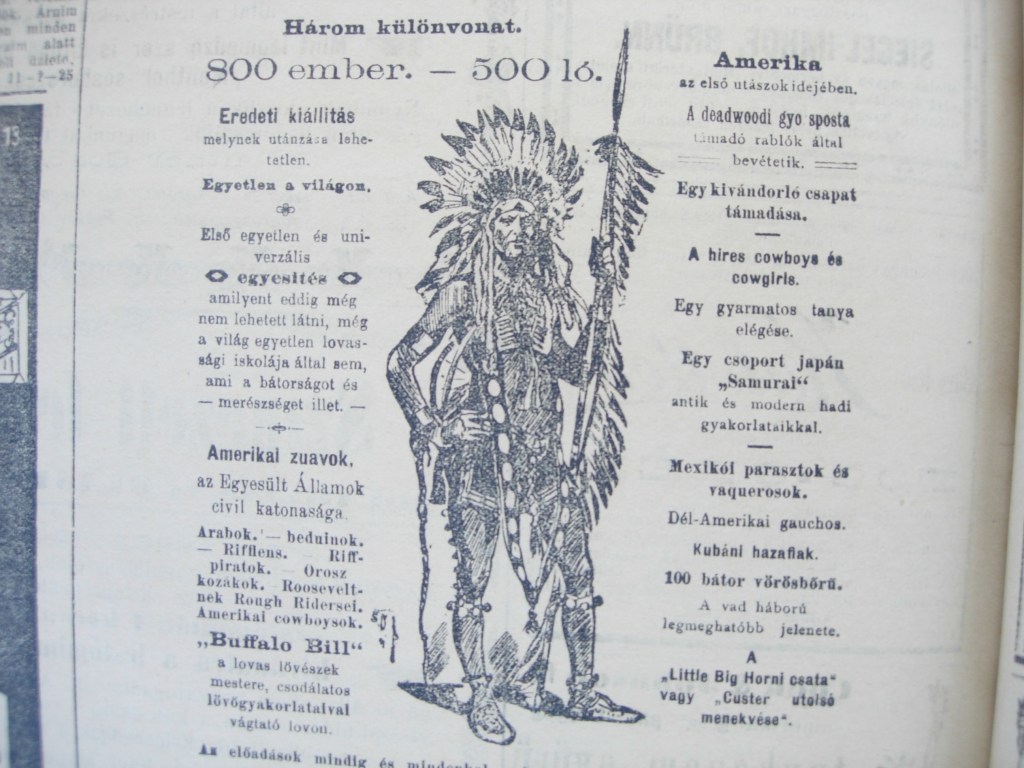
| In Máramarossziget for only one day! Sunday, July 22 in the Market Square Two shows Two o’clock in the afternoon. Eight in the evening There’s no difference between the afternoon and evening shows All seats are protected from the elements Buffalo Bill’s Wild West A Congress of Rough Riders of the World (The world’s most famous rider) Cody William Frederick, nicknamed Buffalo Bill In front of your very own eyes. No other opportunity will present itself to see it again, it’s really the last tour! They’re never coming back. Come to this exhibition. Three trains 800 people – 500 horses |
| An original exhibit, unique and incredible The only one in the world The one and only and universal union that until now was never seen before. American Zouaves and other civil soldiers of the United States. Arabs, Bedouins, Rif Corsairs, Russian Cossacks, Roosevelt’s Rough Riders and American Cowboys Buffalo Bill, the maestro of mounted marksmanship, with his wonderful shooting drills from horseback America, in the time of the first pioneers The Deadwood Stage during a robbery Attack of the Indians Famous cowboys and cowgirls Attack on a settler cabin A group of Japanese “samurai,” with old and modern fighting drills Mexican peasants and vaqueros South American gauchos Cuban patriots 100 brave Redskins The Wild West’s most unbelievable event and the Battle of Little Big Horn or Custer’s Last Stand The performances happen on time and in their entirety in the grand arena Special lighting to ensure a great view The show happens no matter the weather Only one ticket is necessary to witness the entire show as advertised. Buffalo Bill ticket prices at the fairgrounds Standing room only 2 crowns Numbered seating 4 crowns Reserved seating 5 crowns Luxury seating 8 crowns Children under 10 pay half price Advanced ticked for reserves and luxury seating can be bought from 9 o’clock on the day of the show at Istvan Pekker Jr.’s pharmacy (No. 11 Main Square) Szatmárnemeti, July 21 Kolomea, July 23 |
Subscribers reacted instantly to the exotic illustrations and exhortations to action and honor. Some readers may have recalled translations of James Fenimore Cooper, dispatches of the Gold Rush and Indian Wars, Karl May’s Winnetou romances that first appeared in 1892, drawn from Buffalo Bill dime novels and the Wild West’s first tour of Germany in the summer of 1891. Unique American legends already were currency in marketing and diplomacy by the time of this tale from 1906.
The picture of progress, civilization and defense of the settler hearth and home chimed with audiences along the route, themselves a surprising kaleidoscope of people – Bessarabian, Galician, Hungarian, Romani, Silesian, Serbian – and faiths – Baptist, Bektashi, Catholic, Jewish, Lutheran or Orthodox. In the weeks after the fanfare and pageantry, their eyes dazzled by brass and ears numbed by gunplay, more notices for departure from Odessa or Trieste brightly invited this pastoral country of oxen and creaking water mills to join.
Less than a year later, on April 7, 1907, the first film would be screened in Sighet, and the modern age would arrive on the heels of its celebrity friends, modern warfare and genocide, a message that innocuously tagged along with the show, an insidious merge of martial and racial superiority packaged as light entertainment, a familiar contemporary strategy.
There wasn’t time to translate the materials in full, and I asked to photograph the portfolio on the steps of Palace Astra. I’d struck historical gold.
Well, sort of.
Where was my fantasy barn stuffed with posters, dusty plates from the likes of photographers Kabat, Matscho or Ostobolovic, reels of grainy moving image of Bill and Show Indians chasing a giant ball around an arena, even an entire European family of distant Cody or Show Indian relatives?
It was confirmation that the tour wasn’t a hallucination, and I was truly feeling the need to catch up with ciorba and beer across the street to celebrate.
Echim chimed in, interrupting my reverie. “Of course, you could have gone to the Hungarian National Archive in Budapest, they’d have it all digitized.”
Echim was missing the point.
Like a cloud that searches for rain, I wanted to gather the artefacts of the Bill’s last Wild West tour on Europe in situ and to follow the Habsburg route from Trieste to its capital Vienna, then onward to the outposts of Eastern European empire: Budapest, Belgrade, Brasov and Lyiv and the points between, places that weren’t that far apart on a prime rail network that at its best took five hours to reach from Budapest to Sighet, and now took a day. The sole movement here was in human slaves and tobacco brought across the river from Ukraine into what, believe it or not, was a cul-de-sac of the European Union.
All I needed was a doppelganger to help plot the route for witnesses, legacies and ephemerae of America’s first cowboy ambassador, riveting and even tragic, sowing the seeds of European upheaval to come.
Bohemian Rhapsody
Bill restarts in Europe


Bill plans to dump his cramped apartment and buy a new one. He needs space, room, light and air. As impresario, he’s got to squeeze in ideas, performers and beasts, and they all need a place to sleep and park. Maneuvering the rodeo requires skill and resources. He’s wasted four months of the winter off-season practicing for a stunt of size, elegance and price that meets his criteria before he’ll relinquish any funds for a production. The move is calculated by the margin of the air passing through the gaps in his teeth, but the search just goes on and on. Nothing’s right.
He’s pedaled up and down the flat districts of the city with a classified gazette, map and a phone card, earning the scorn of the estate agents for not being hip to a mobile phone, essential for clinching the deal he’s hunting. What do they expect from an antediluvian guy prematurely grey, tossing his flowing locks over the shoulders of his corduroy waistcoat? It cuts both ways as he mocks their indifference and unprofessionalism. Unfortunately, they’re the gatekeepers, and it’s hard to get directly to the owners. It’s not the first time he’s encountered officious people out of their depth, and it’s been one hell of a time.
Bill locks his crummy bike and studies the latest estate agent.
Claudia flows from her petroleum blue Opel Astra, hikes up her crochet dress and lifts herself from the rusty cockpit. She’s got potential. She’s panting, as if she might have hoisted herself from the tanning bed, both her globular breasts rolling from the bra she has chosen as outer wear on this brisk morning.
He’s impressed and not until shaking his beaten hand does Claudia claim the value-for-money search is over.
Her bronze skin smells like the ordure of a solarium or a bum. She raises her hammy arms above her cheeks, her hoop earrings and double chin shake and jiggle, and she’s almost appealing, her bosom heaving from the effort of keeping her body going as she totters into the lift and leads the way to the flat that is going to be his. She already knows it.
He don’t.
The selling point is that it is divided into two flats as he chomps down on the price later, carefully ratcheting down Claudia’s offer as she speaks in her flat poker tone resonating from her rippling throat pinning her phone to her shoulder. There are birds chirping in the audio. Her heels are clacking over terracotta. She could be on a terrace or in pet store naked as she hears his offer for an upscale bit of the ghetto. She’s a bit stunned by the offer, but he indicates that he wants to play poker.
The happiest weeks of Bill’s life are those days living among the boxes. The ceiling is cavernous, and the layout is grand. From each of the four rooms that are the living quarters, he can see the peaks that define the shape of the indescribable city cleft by the great brown river. This is the place he should have landed in since the beginning of his exile, but it took years of wandering to find himself in the right circumstance to make the purchase. A horse or three would fit in the grandiose elevator.
One evening Bill hosts a group of hard-thinking, high-strung European women capable of emasculating a man in a breath. He vows to shut the door so they won’t bother him. Despite his best intentions he showers and shaves, changes into his kaftan and imagines asking any of them to come to his bed if they would have a hankering. He’s already cooked them steak, rabbit and kidney pie, and they’ve eaten the mashed potatoes and quaffed from the bottles of wine rattling in plastic sacks that he inserted in the new fridge that seals hermetically with a sucking sound.
A French gal is pontificating on the futon. She’s a natural ideal of energy quickly inserted into his routine, about how she will work, how her projects are, what they mean. It’s a lot of me. Which one is she? He’s certainly not explaining his own business or detailing how he manages to pony up and pay all the bills.
Somewhere among the massif of books piled on the floor are nuggets of medicine that have come either from a generic plastic bag or from the pewter tea pot. He doesn’t know what to do with the excess of flowers. Bill thought his habit would be another way to initiate the new apartment, but it’s not really working, certainly not with a girlfriend, at least he thinks she’s his girlfriend, with whom he has been bickering all day about money and their excursion in the Alps, and another one scheduled for October in America where he plans to drive her around in his pickup with one arm on the wheel, another around her waist and another hanging out the door.
“There’s a price for everything,” she says, and he glumly nods.
How did she choose the most expensive part of Europe for a holiday after draining the account? What’s wrong with the new fort?
These girls certainly had traditional values.
He did insist on the 400-buckaroo boots to feel comfortable. Bill’s not a mule and his feet are going to glide across Alta-Adige. He doesn’t mull over the faulty logic and masochism of the idea – new boots plus hiking equals yikes! – but he does realize he wants truffles shaved on fresh pasta and smoked, fennel sausages at any altitude.
She’s got a new haircut for the occasion, the thick brown stuff shaved over one eye and behind one ear. She’s looking and listening to him kvetch in the only armchair.
“I’d rather get a drill and make some order,” Bill says.
“It’s not happening with your biking, frisbeeing and stunts soaking up all your time,” she says. “You’ve been up in the hills riding almost every afternoon like a dumb boy.”
She’s triumphant and stabs him in the gut with her toe.
True enough, her marionette, he zips up and down the imaginary wires that cut through the forest, and he follows them higgledy-piggledy, then dropping back into the city, most probably spent for the day if it were not for the sand and grief in his eyes.
He acts deliberately at the prelude to Kali’s two-night birthday bash. He has four shots of vodka before arriving and brings the rest with him. He begins with the schnapps and water to moderate the perception of a buzz. He ignores the wine, beer and pastis until he’s ready to soak up the booze with garlicky Romanian distortions of taramasalata and baba ganoush.
Bill squeezes among his girlfriend’s friends and situates himself among the faces, legs and breasts. Nice there close by Kali. His girlfriend is looking piqued and isn’t feeling well.
They laugh all weekend about her not feeling well every ten minutes.
“Funny,” he says as her diagnosis changes from cramps to eczema to gingivitis.
He can’t do anything but gleefully sympathize after hearing so many complaints in so little time.
Bill’d sleep with any of the girls in a flash if he were his own man. But he’s not, and it’s not going to happen unless she’s involved, which is mostly likely a no-go area. He’s not engineering it either: Do you like your friend? Don’t you want her? Don’t you think she’d like you, too?
He’s been looking these girls over, the ones that he can touch and talk to on the sofa at the party. He’s not crass, wandering from table to table asking, “Are you straight?” culling three partners a week like a troll loitering by a bridge. And he’s not doing anything special when he gazes into Kali’s cleavage as she poses on her knees over his thighs. He cannot imagine fulfilling the temple priestess, more than equal to him in bulk and body, at this little closed gathering of female friends.
“I’m from a woman, too,” he jokes, properly bold now when he rubs Kali’s box through her trousers, and she rightly stings his face with her hot hand.
Bill does not have thirty centimeters of dong and liters of cum at his disposal.
At the public party on the second night, she’s danced glass into her feet and shagged her way from table to table, drop by drop drunker, ornerier, louder and hornier.
Bill is among the first guests though his head is guillotined by the schnapps.
Kali’s got a bent nose, a flower dress and a fistful of flowers for her birthday. He hasn’t requested that she take off her underwear, but she certainly is rubbing something silky under his chin. Seeing that he’s recovering from the schnapps and sober, he’s not at a point where he can react.
The Armenian accordionist is in a foul temper and the Romani musicians are not playing. They’re sitting in a corner, keeping a collective eye on their women. They want money to play and no one’s surrendering a cent.
The venue’s owners don’t have a permit, and they don’t want to pay either. Typical of hospitality, they’re always looking for an explanation of why business is the way it is. The great brown river is low. The clientele is not drinking. The night is one degree off ideal. The moonlight is too strong. The beer is slightly sour. The wine is too warm. The wind is blowing too hard for the disk to cross the island.
Bill shivers in his wood and iron chair. This wasn’t what he signed up for. Mr. Potato is blinking behind his rimless glasses and licking together a date with Mary Jane. The drug and bicycle messengers are coagulating around some videos and a resistance machine that hums through the plywood of the stage decorated with pillows erected against one fence of the island garden. Scene chicks (not nearly as titillating as the day-to-day street chicks) are pulling on their cardigans and adjusting the chopsticks in their hair and going to the toilet in pairs.
The soil is red like a tennis court and the ball of conversation is serving and volleying from mouth to mouth. People are firing requests for beer, cigarettes and grilled, blackened fat.
Kali is shouting and pushing in her dom way, pulling the unwilling to her U-shaped table where the lights are dark, and a trio of women talk in the deep octaves of modern peasant cosmopolitans. None of them drive but they can all hitch a horse. Wrongly or rightly, they believe they will be escorted in the world until their escorts die from alcoholism or angina; then they will never leave their flats except to buy a new radio, new teeth or a new plant.
It’s been a long night of silence for Bill. He can only reflect on his hangover. He’s not pulling Bataille from his blazer pocket and touching his flavor-saver. He’s not screening his documentary on graffiti. He’s not a visual anthropologist but he’s still fascinated by the four walls of the garden that contain the words and gestures of socializing humans.
Days later, Bill squats in the sand on Mosquito Island. The great brown river is mewing against the bank. It’s turgid and almost too frightening to swim in. Even here, mid-route, the water is a mess. There are a few oily clam shells and some pebbles corralled at the edge.
He doesn’t open his eyes under water. He wades in and it’s raining. Bill decamps to the Lake Pub and enjoys a small beer and a coffee to avoid getting any wetter. He looks into the brown eyes of his girlfriend, who is looking relaxed and beautiful. He doesn’t remember bringing her. A mystery himself, he’s trying to decode the crowd of headbangers, fisherman, Roma and yuppies reflected in her brown eyes.
The shower relents and they’re soon playing on the wet sand, throwing a disk between them. She’s hardly any good, and she objects when Bill voices his obscene thoughts, telling her to flick her wrist like it’s a good day in bed.
“What!” he says, defensive and unfurling a litany of proposals. “I’m not piling logs on a fire and forcing you to jump after smoking a joint made from newspaper and bark. I’m not arriving with a case of beer, a cooler, tent, fishing cap and deck chair. I’m not camping on the beach for weeks with you as my wife and progeny. I’m not bivouacking with a group of friends from school, sorting out who’s going to screw you. I’m not sleeping with your students. I’m not having a make-out session with a group of other couples spooned together under the willows. I’m not carving up the mud with my motorcycle. Now, just throw the disk!”
Bill doesn’t have to try too hard to send a forehand or backhand. Catching it is the problem. Especially when it arrives with no spin and a weak trajectory and collapses into the sand like a wet dead fish. He’s pleasantly surprised by her growing backside in her swirl-pattern bikini, especially when she moves enough that it might be considered running. It doesn’t surprise him when he’s got his tongue buried in her hell hole.
Some guys lock up their dog in a shack and leave the CD player on repeat and Bill dances a bit to abstract Ethno as the sun goes down and the chill rises from the wet sand. He does not wade in past his waist, exit, then run and cartwheel or backflip into the water – even if he’d like to since it’s the right time of summer yet minus the right degree of heat and suffering that would make it mandatory.
No one is crashing into Bill’s fire, earrings and Mohawk pressed into the grey peppery sand. No one is dabbing bits of paper on their tongues and calculating if they are beginning to “feel it” while ploughing through booze, resin and peaches they have brought for the night. No one is running down the beach with a brand in his hand like a headlight. No one is maniacally laughing up to his neck in watery sand. No one is swinging over the river from star to star.
No, it’s cold and summer and he’s prone to the great brown river, beads of silver and green foliage smashed along the shore, flowing into the approaches of the great brown city downstream.
Scout’s Rest
Bill’s ranch in Nebraska


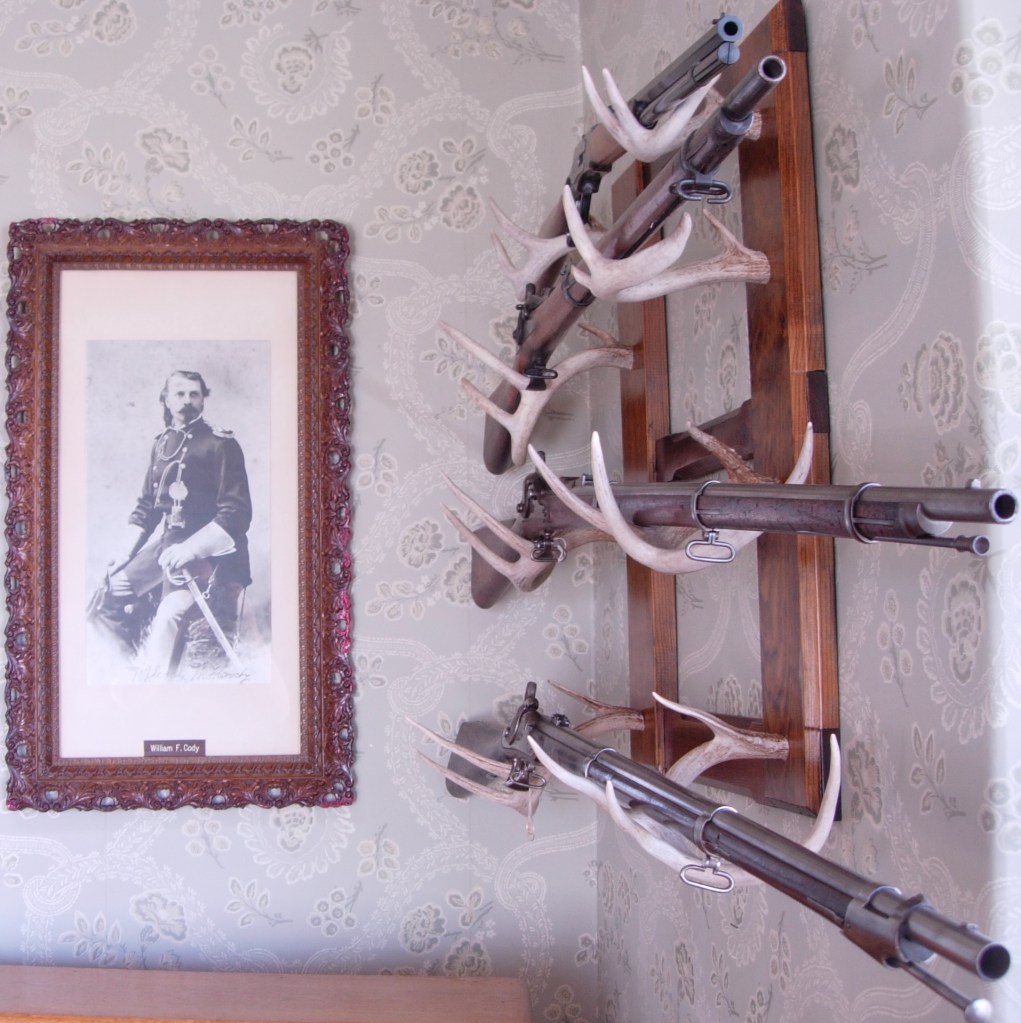
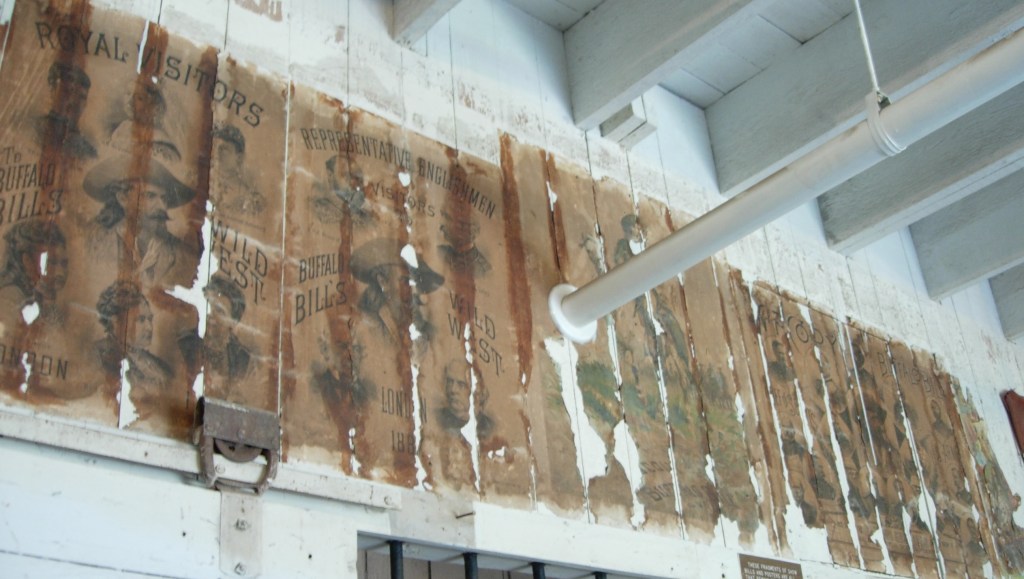
Bill Cody avoids where he’s going before he gets there. Bankruptcy – moral and otherwise – is too familiar and unpleasant to dwell upon. The discomfort grows to the point that he considers a pause for some company, but the only pull aside with any guarantee of female candy under the age of 70 is back at the state line in Henry. He’s not edging back an hour just to watch a saggy bottom cancan and flying boobs to sip a bourbon and coke. Still, he recognizes he needs some solace for his violent frustrated memories as he skirts the Sand Hills, dogging along the Platte, wanting to veer towards Colorada for a toke even if he’s firmly stuck in Wyobraska.
He follows the yellow flags pointing south to Cabela’s, and he recalls the mercantile’s bargain cave was a heaven of merino socks. He’d rather avoid the discomfort of bearing north to Pine Ridge to be scolded by the children of Black Elk and the other Show Indians.
He parks and lines up with herds of Bubbas dismounting from their oxen, wagons and vehicles.
Inside the warehouse, partly deaf from a lifetime of gunplay, he picks out a pair of great horned owls’ hua-hua-hua on Cabela’s in-store soundtrack, calling deeply to one another from a dark, harvested beanfield, making friends. Judging from the dudes sighting rifles from the cabinets of weaponry in the gun library, he ought to spring behind the dioramas of cinnamon-maned elk, bobcats, grizzlies and bighorns, and hide along with every tasty specimen of prairie and mountain critter in this temple to hunting, every accessory known to killing animals within its thin metal walls.
Bill’s so nervous he’s about to dip behind the aquariums stocked with bass, catfish, pike, walleyes and scarpies. If that fails, then camouflage himself within the bad tailoring, conservative browns and relaxed fit of the clientele among the field butchery supplies. Then he spies what he didn’t know he was looking for.
Big Buck Hunter Pro.
A few quarters later he’s well above Laphan Cedarburg in 61st and skipping past Carmen Rodriguez in seventh in the top scores, navigating with his brilliant marksmanship towards number one, sufficiently skilled at shooting to know he’s recovered from his sour mood, a taste of the glory of yore like a trail of bled out buffalo, their juice leaking into the carpet, fire retardant for the petroleum industry, not to be squandered on prairie floor.
His name glows in pixels in the video game cabin by the time he limps outside, his shoulder sore, his eyes dazzling, the prairie sweet and real from passing rain.
Bill scoots down I-80, ignoring the signage for cabins at Lake McNaughty, sometimes site of his season tour afterparties and out-of-hand staff retreats. He passes thousands of crop circles, the corn as tall as cavalry, till he makes the hairpin and loops over the dancing banks and islets of the river, cuts through 10 blocks of residential housing, cruises past the gothic Pawnee Hotel for vagabonds where he’s ended up a few nights himself in a long, fun, tortuous life, and humps over the railyards till he recognizes what fragments are left of his home in the surrounding neighborhood of farms and trailers, rodeo stands, the ranch just past the Scout and Lodgepole Motels, sprawling places with thin walls and whores.
His home is a state park now, and he lingers by the rebuilt cow barn that burned down one night when he was touring in 1904. He’s just another face to the guide, no one special, maybe chiseled more than most. And without the goatee, locks and hat, and unaged, who’s to tell him from the local impersonator, Bruce, available for a fee on 530-0990 or 530-3509?
Aric unravels all the trivia in the sprawling wooden house. He repeats all he’s learned, “Scout’s Rest was owned by Pawnee Bill after collecting Bill’s debts, until Orvil Kuhlman, whose son is Ernie, our current neighbor, purchased the house. It was his up until 1960, when the state of Nebraska bought it.”
Bill drags himself past the cob house, spring house and icehouse just outside, nods at the hands’ bunks and recalls the separate bedrooms all too well, as if Louisa were chasing him away with scissors and threatening to desiccate his balls again.
He can’t help but be skeptical about a simulacrum of kitsch, schlock and time plus celebrity, where a narrative about him is sliding around, changing, stabilizing around sites, and then manipulated and sold as photographs and merchandise, hats, hot sauce, toy drums, cap guns, buck knives, post cards, silk screens, posters, dioramas, pronouncements and artifacts that have been saved and reproduced.
Okay, he admits he encouraged it, and he needed the money from signing away his image and copyright. He laughs for a spell until a hiccup interrupts his reverie.
Bill willingly was reproduced as manikin, statue, billboard and town mascot and functions still as a dime to the North Platte economy. He egged them on of course when he put on the ceremonials of the Indian, when his identity of prairie, page and stage collided with comic books detailing exploits he’d never done, the epic of aboriginal versus newcomer, the sites of which are marked along the highway of this strange watery grassland of Nebraska, of creeks, lakes and reservoirs segueing into the arid high country adjoining the Rockies, a last breath at Wyoming’s Independence Rock.
Most don’t bother coming to the house. They just stop at the Trading Post along I-80 and stare at 20,000 balsam wood miniatures whittled by Ernie and Virginia Palmqvist. Drop in 50 cents and the diorama quakes to life in all its magnificent, ordered chaos conjured up under electric lighting: five cent balls and shots for games, calf wrestling, teepee raising and travois dragging, spear throwing, war dancing, drumming, lassoing, bull fighting, trick shooting, bronc riding, horseshoeing, saddling, magicking, juggling and fire eating.
Good value for a helluva good time.
“I was a goddamn genius,” he concludes as the balsam figures come to a rest, among them so many he recognizes and wants to talk to again.
As guide, courier and showman, Bill of that day and hour quenched the thirst of a civilized public in the East and suffering settlers out West. Both audiences wanted romance and adventure, an easy win-win hero. Only he could tame what could not be tamed until the dénouement of the Civil War, addressing the trauma of E Pluribus Unum, answering the wish for glory, a bandage on a public memory of atrocity and starvation long before widespread photography. When hearsay was the same as truth, or near to it, memory made of fragile words prone to lambast and exaggeration in print. When wonder and curiosity were found in the division between that the world that was made and the world that was given. Where story and the cracks in the world at dawn and dusk made knowledge. And there was enterprise in capturing this tension, especially when sold to metropolises like Chicago, St. Louis and New York, to the middle ground, places in between that offered neither urban nor wild adventure, or faraway lands like Paris, Vienna, Munich and Glasgow.
Would it be the flat, golden prairie out the window? Oh, it was flat and full of surprises – anything that moved was a surprise when a man was left to his own lonely devices, so if he could manufacture something out of the grasshoppers, drought and tough conditions, once the Sioux and other tribes were conveniently eradicated, to make him prosper, some myth or mystique that would linger in the collective consciousness that could be packaged, managed and sold, the raw ingredients of a predatory capitalism, then it was suddenly way more than mere grass and brush, flowing to deserts south and tundra north. Indeed it was a factory of legends, as powerful as the sea, on which to implant one’s feet, and certainly having escaped the tyranny of the feudal villages of Europe, the promise of empty land would bring them to enterprise and mostly fail, still in fact servants to interests more powerful than them (beef, railroads, mining), and thirsty for something or someone who would make them feel comfort that their lives had been worthy if not heroic.
Bill and his enablers understood this, and the entertainers that followed – people wanted to believe in something they weren’t – a dream essential to the American psyche of social mobility and personal enterprise. His ranch house, a wooden equal of the brownstones, the grand style and entertainment, the unattainable made real, at least its veneer, the showmanship a cover for boozing, womanizing, and what’s under that – an inferiority complex and probable depression.
No, these are not irrational presuppositions but an intuition into this over-lauded character. Imagine Cody now as an imposter trying to live up to, or authenticate, that myth, when all that is left is dry ground split by the highway and dotted in places with franchises that have nothing to do with local other than paying tax, if that, communities emptied by time, circumstance, a lack of opportunities and held together by agricultural subsidies and little else, at least economically.
Even if all the Buffalo Bill Cody-s convened together, they would be powerless to roll back time like Elvis (or any of tired star of the past). Cody is just an avatar for which, through which some live their desires, especially if they’re losers or failures already (and how are the winners then?), shaking hands and greeting at the Christmas ball (annually at the ranch, a Christmas tree in every room).
Cody hates Scout’s Rest and all the loss it stands for: the marriage, the children, the tours and the fame, the constant restarts for which he can only blame himself. He stomps to his truck and peels away, heading into the Sand Hills and the solace of the grass ocean.
Pity now is an age without need for heroes.
Europe Bison, America Buffalo
Bill reclaims the Fourth in Szeged

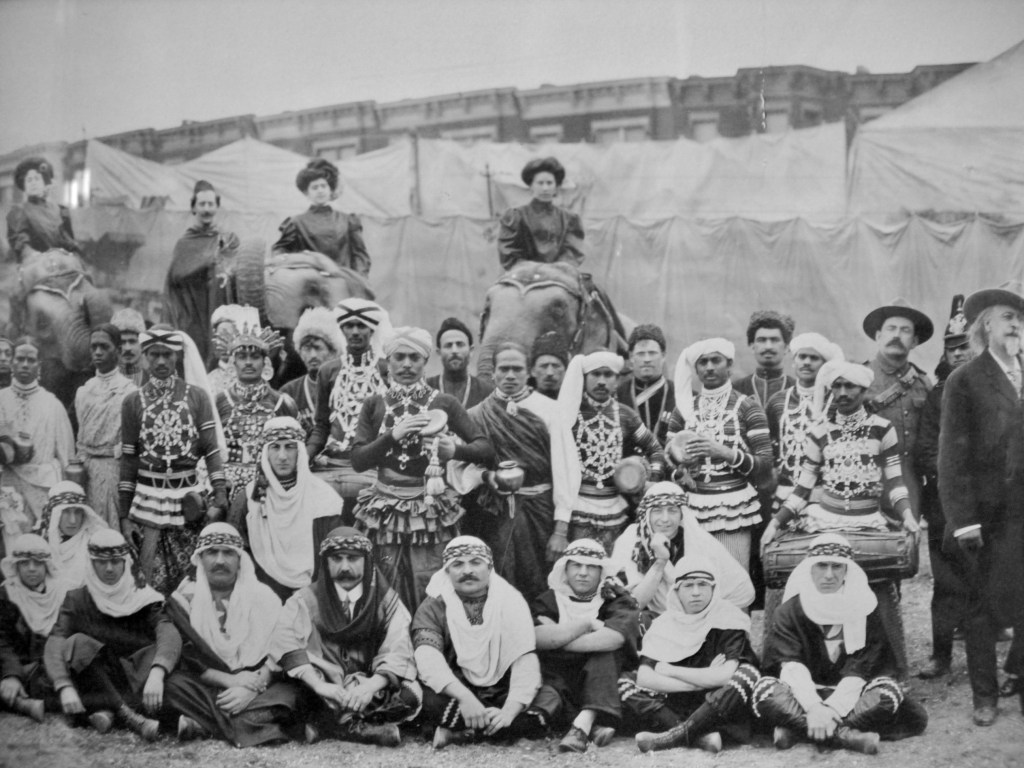

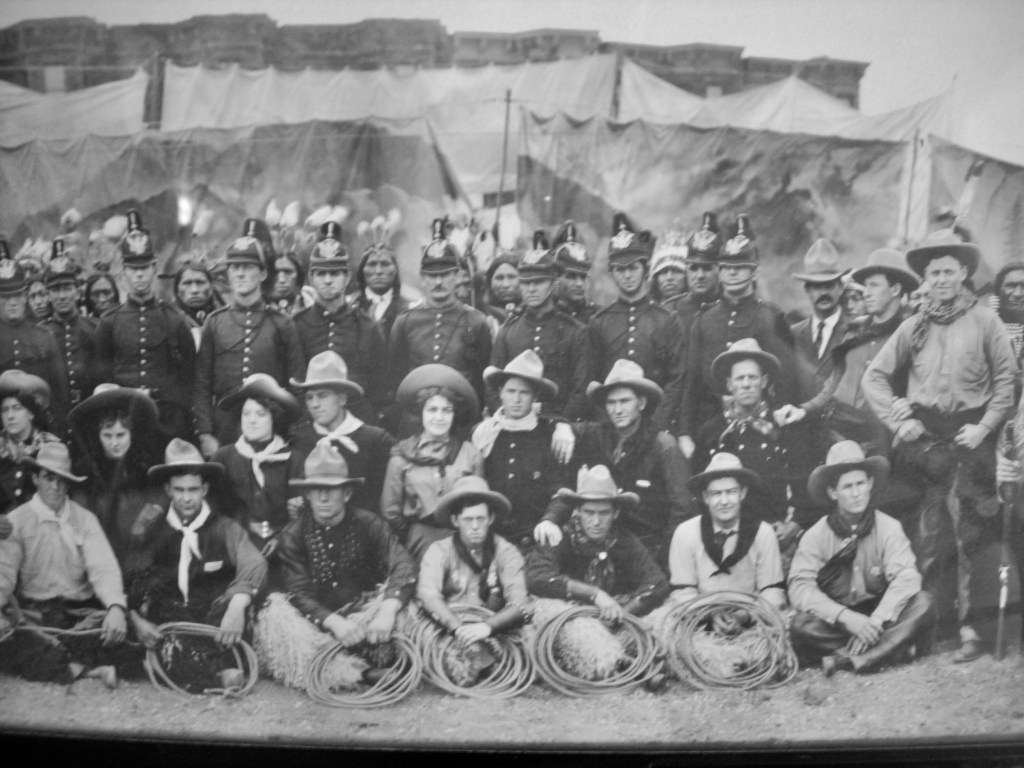
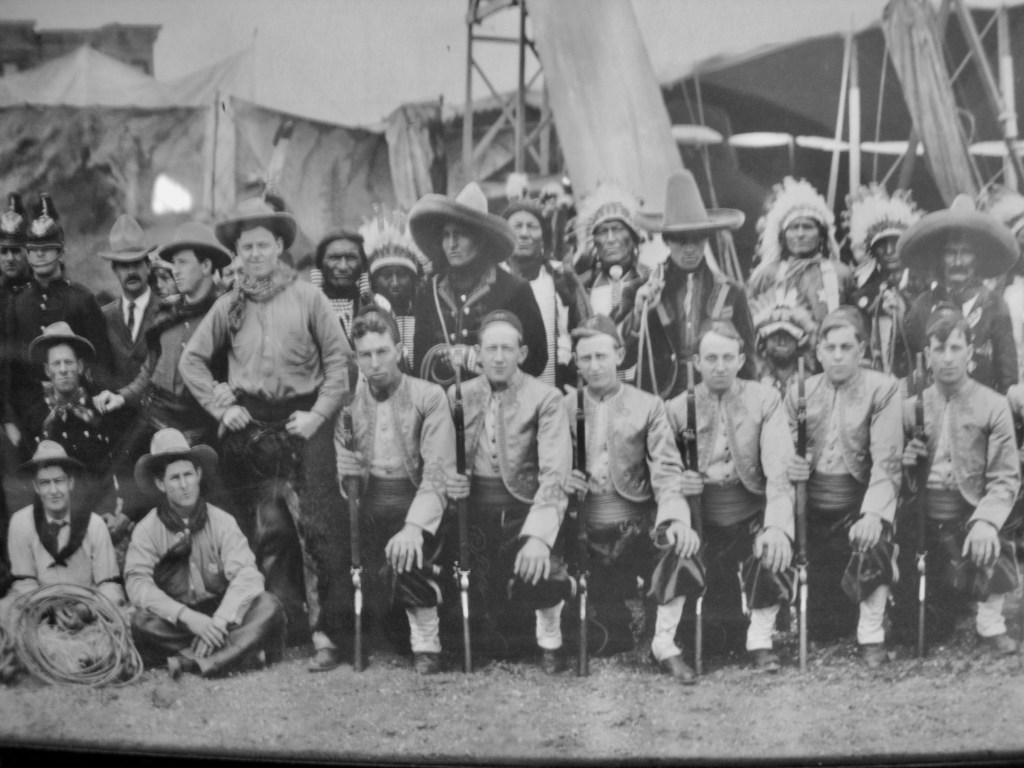

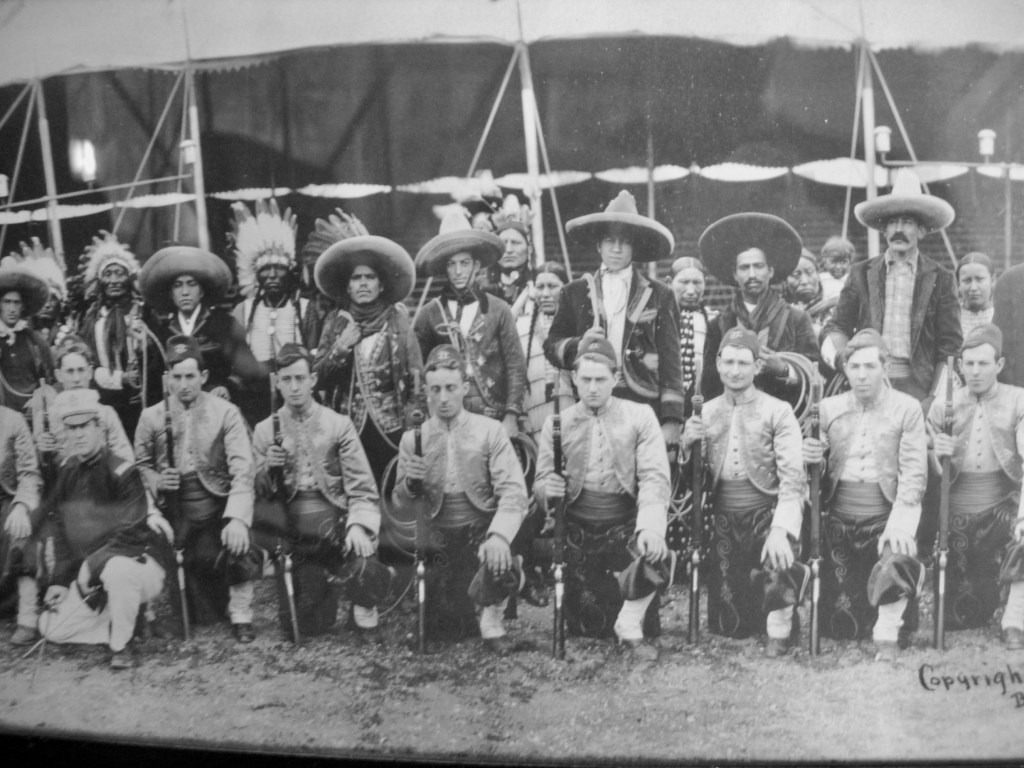


The car park was full in Szeged on July Fourth. The parade ground too. The sticky murmur of the crowd rose through the dust kicked by the wind. Few Indians of any stripe had made it to Hungary’s southern city of paprika and sausage since 1906. On this centennial, it was no other than Buffalo Bill and his troupe of irregulars. They’d entertain the townies enticed by colorful posters and bold handbills, drawn to the promise of danger.
Bill was the most famous of Americans, so the media said, the messages deftly crafted by show’s publicity office in advance of Buffalo Bill’s Wild East. They didn’t mention that he was 160 years old. That he was an industry. That he was washed up.
His manager had trouble explaining the idea of the Wild East in his posts. What to expect? Mafiosi, strippers, fast cars and new rich? Ned’s performers looked more like degenerates whom he’d managed to sweep up from the dustbin of history. They were less than noble savages. What did Buffalo Bill have to do with such hard times and mismanagement?
Ned said it was branding: Disneyland Paris owned the rights to the Wild West but not to Buffalo Bill. It was a stroke of genius that he’d managed to get Buffalo to sign up, as the Wild East was on the cusp of failure.
Bill, like his glass of whisky, couldn’t know that.
The star didn’t even bother to inspect the show on the day he signed. He assumed that it was fine.
From his trailer, Bill squinted through a spyglass at the stands on a torrid July Fourth and watched the kiosks. A hot enthusiastic sun beat on the grandstand, sparing the luminaries in the shade. He concluded they must be doing a roaring trade in Stetsons across the way, judging from the dun disks skating under the sun. The electric lights dipped in streams above the crowd who, refreshed with beer and popcorn stamped with the Buffalo Bill name, didn’t object to the heat, even at this late hour. The show was about to commence.
He smiled grimly. Dazed, drowsy, he wondered in all those years if the salami factory still operated in Szeged. He’d enjoyed seeing how the Hungarians rodeoed the pigs decades ago. He was back for one last farewell never to return. So he figured.
Bill knew that he was an incorrigible soak. After cups of afternoon fire water, he’d awoken far too late and missed the troupe barbecue – and the parade that led through Szeged to the arena and drew in the crowd. It was a shame on such a sterling, patriotic occasion that his habits got the better of him. But the roustabouts and performers were reliable, and Ned knew better than to wake Bill from his petulant slumbers. His hunch that there’d be more grub later after the fireworks was not misguided. The show never, ever lacked for a spread. Ned made sure of that. It was in everyone’s rider, just one of many fillips to instill the performers with loyalty.
The crew had unloaded and put up the tents.
“How hard everyone works!” he exclaimed to Szeged’s mayor, here for the preliminaries.
Now they called it edutainment, and the new show was cause for the mayor to linger and study the lessons in how the Wild East was won, if not by genocide or war then by the Yankee dollar. He wondered if Buffalo had found any room for improvement. The East had been stubborn and refused to bow, though many people had tried.
With the ease of a veteran, Bill didn’t need much time. He had his lines and cues down pat. The show had changed little, even after all these years. He wiped the lipstick from his face. He retrieved his wig, wedged in the couch, tidied it and dashed it upon his head. He combed his moustache and goatee. He’d never squeezed out of his leggings from the previous night. He had only to toss on his buckskin jacket in the way of costume and buckle up his guns. Unsteady on his feet, he wasn’t sure how he was going to manage to peg the glass balls on this evening, heat unrelenting and humid too, something that didn’t agree with his crusty body. It wasn’t what he called good riding weather. He fastened his cravat to keep the dust around his neck at a minimum, flicked his hair over his collar. Just like olden days, he hated baths and preferred a bucket. He sincerely hoped his mount didn’t feel as rotten as he did.
He studied himself in the mirror and laughed at the idea of being here again. He didn’t look exactly like Bill but that didn’t stop people from thinking it was him. Shoot, it barely stopped him. The problem was that Buffalo Bill’s personality was so strong it tended to take him over and he began to believe that he really, truly was Buffalo.
Even in retirement, with no more than a Stetson, a pair of boots and a well-trimmed beard to signal any kind of flashy rodeo dressing to indicate he lived the role.
Fans would stop him in the street and ask, “Bison Bill, huh?”
“Buffalo,” he’d correct them.
Sometimes he liked to josh, “Nope, Bison Bill, like you said. Not to be confused.” He smiled handsomely, tipped his hat.
He guessed it was his pickup, a gas-guzzling beast utterly uncommon in the East.
The fame soured him to the possibility of who he was. The doppelganger, the Buffalo Bill who was supposedly dead, had lived on as a legend. Being buried on Lookout Mountain was no obstacle to an ambitious man, his body refrigerated until the road was clear to the foothills outside Denver, mourned at his grave by six lovers and one wife. He tended to take over anyone who was willing to step into his cold boots. Then came all the bad habits, flaws and orneriness.
“The original celebrity,” some people said. That’s why he’d quit. He’d forgotten who he was, and it wasn’t that grand living as an anachronism, a knight in a world that no longer needed such men.
He had no regrets. Like his namesake, they’d lured him back with the bonanza of a Farewell Tour. It was irresistible, even if he wasn’t the real owner, something he begrudged as only Cody could. They’d milk him for the next decade, he was assured. In a flash of sobriety, he’d taken a magnifying glass to the fine type, about as alarming as tallying all the pay spent on hooch.
“Cowboys are the new Renaissance!” Ned had said, slapping Bill’s buckskin coat. “So long as you can stand, speak and shoot straight, welcome to the Wild East. And if you can’t stand, we’ll strap you on an ATV or the stagecoach,” the impresario added none too prettily. Ned predicted market share beyond a niche of cowboys and Indians in Europe.
Buffalo Bill had returned to show business to regain his own sense of being; he was ambivalent whether he liked that person anyway, whoever he was. Since quitting the show at Disneyland Paris, he’d done very well by his savings. He had lacked for nothing. What masters of illusion they had been!
It had been a long journey when he thought about it, returning to Hungary, returning anywhere. It was a victory. He was rich. He was famous. He lacked for nothing. For some peace, he had moved to Balaton. His expenses were little around the lake, but the place didn’t sit that well off season, emptied of flash and bling. He was sure he was made of something else.
The peasant house he fixed up with a modicum of modern conveniences. For a lark he pitched a tepee in the orchard and there he spent most of the time. He ordered lodge pole pines from Slovakia and bison hides from Poland. He paid a squaw from the mock Indian camp nearby to stitch the skins together and decorate them with the signs of the prairie. He paid her to do the sewing in the nude, such was his sense of humor. She didn’t mind it either. Then he wondered if she was his mother, lost to Hippie counterculture. Like him, had she gone to America to live on the Big Res, too?
It was an idyll under the tepee. Outside, he urinated and defecated on the tent flaps tucked under the rocks of the tepee ring and he didn’t care too much about the odor under his professional code of authenticity. All in all, he was talented and didn’t lack flair; he drawn to nothing fancy like a house and crazy enough to forge stirrups and sheriff’s stars in the name of reenactment. In that way he differed from his predecessor. Even his tour trailer was nothing special. What he needed were booze and women, never far in Central Europe. If he had outlived his widow, he would have sold the dreck at Scout’s Rest.
Unpleasant reminders remained in the Hungarian village where he had grown up in rags. A dude ranch for German tourists. A summer rodeo of pitiable merit. Donkey rides. But the mock Indian camp populated from the 1970s by a bunch of slackers and Hippies who believed themselves to be a lost tribe of Hungarian aboriginals was the most sordid in his mind.
As a masseuse and the lowest sex object in the camp, his mother had raised him in a wigwam waterproofed with tarp. He had grown up like an untouchable and hated every moment of it, or so he thought, except when they were chased into the forest by Hungarian secret police wanting to arrest the Indians for betraying communism’s work ethic. The police weren’t willing to run that hard for their meager salaries but at least the game of resistance took on a shade of consequence.
For that he was grateful. He had decided to become a cowboy in this nest of Indians. If he had his way, he would have lined all those mock Indians in the sights of his love, Lucretia Borgia, and liquidated them. The long, heavy gun felt like history tucked under his chin. Heavy, cold, remorseless justice. No more cheats for chiefs and sluts for squaws and the daily internecine battles thereof. No more second-rate mythology of pretenders.
They were all fuckers. Some of them still were alive pretending to be Indians. It was he who was a quarter Navajo blood. “Thunderbird was your grandpa, a poet,” his mother had said, deluded on drugs he was guessing. She’d never said who his father was. In that environment with that anger, he had learned to be the ultimate of reenactors, Buffalo Bill Thunderbird. He was whoever he wanted to be. That was an American lesson. He could reinvent himself as many times as he liked.
No one suspected that Buffalo was Hungarian in America after a time. A degree in ungulates was useful to his surprise. Once arriving in Saint Louis, he had ignored the restrictions of his visa, secured in the euphoria after the fall of communism, and moved westward. Old enemies were welcome and grudges were paused. He erased his accent and adjusted a cowboy legend he’d pioneered at home with the original: breaking horses, working on stud farms, training quarter horses and when forced to, roping cows. A few times he opted to take other jobs, since it was easy pickings. Driving 300-ton coal trucks at Black Thunder Mine had been okay. He did his best to fit in.
Among jobs and having tired of target practice with his arsenal, he’d find himself looking for something to do, no family in America, or so he had concluded as none of his searches for a grandfather yielded a scrap of information. The mystery of his birth was not forthcoming. Yet he gassed up his pickup, hitched the trailer, loaded his horses and tried the reservations up north, asking for Thunderbird. The people of the first nations had laughed at him, a long-locked, bearded, buckskin-wearing kid who wanted permission to pack in their backcountry too.
“That’s a brand of car, ain’t it, kid?” they said, deflecting the question.
Buffalo Bill’s command of subtlety wasn’t firm enough to know they were insulting him and Navajo, too. He didn’t know that Indian tribes were all about politics and turning the tables on an opponent. He didn’t realize the colonizers were vanquishing their colonizers. The exploiter was being exploited, quite unbeknownst to him. He was far too dense in that way.
It was their suggestion one day as he hung out in a bar near the Res. He had struck a nerve with braves. He had encouraged them, buying rounds of whisky with the embers of money burning a hole in his pocket.
“Buffalo Bill, ain’t yah?” a young man had asked.
He shook his head. “If you say so.”
He wouldn’t say Thunderbird again.
“Rodeo tomorrow in Green River.”
“Going?”
“You betcha. Got all my fingers to hang on. See.”
With that invitation, Buffalo Bill had outdone everyone and baptized himself, making the name stick. He entered the rodeo as Buffalo Bill and won the bronco riding convincingly, mounting the broncos in the chute and hanging on well over the nine seconds required for each ride. He had even shown off, mounting a bronco in the ring with no runner, no chute, drawn his pistols and shot out some of the rodeo lights. That had clinched it. The audience hooted and yelled in appreciation. They’d only heard of what Buffalo Bill could do in his long migration through the American consciousness. He was a champ and he embarked on being the man he was told to be.
Buffalo Bill’s personal assistant rapped on the door of his trailer. He held the reigns to McKinley, his roan, and had brought the box of guns and the wireless microphone for the show’s star.
“No regrets,” Buffalo Bill said to calm himself. He was relieved the memories were interrupted. He pulled his gloves off the table, walked outside and fragilely negotiated the steps to his trailer. The stark brightness of the day had relaxed to an opaque light and arena would soon throw its lights into the darkness.
“You’re mighty fine today, Mr. Cody,” said the youth. “How’s that wireless mic I taped on yah’?”
“Rest of the time, I’m unmighty and unfine, that it?” he quipped.
Bill looked a trim fifty with his golden hair. He didn’t mean to be sore, but he was irascible and irredeemable from the whisky. He might as well add uncouth. The kid sound-checked the channel, the device patched into the small of his back.
Szeged seemed a damn fine chance to feel the glory again. He’d forgotten about that part, the glory, since renouncing showmanship, since even the last show when he’d argued with obdurate Ned. The band was serenading the crowd with the strains of cowboy music, and he mounted his horse. His assistant handed him a Winchester. He slid them into the saddle holster. He had riding to do.
With a kick, he surged forward, and McKinley loped through the camp of trailers and parked trucks carrying his portly load. McKinley smelled the drool of the buffalo, and he smelled the spit of crowd and he dreamed of the flowing gun smoke to come. It didn’t bother him one bit. He headed straight for the group of riders holding flags and they fell in behind Buffalo Bill. They were a well-trained bunch, hardy and tough. It was precise, dangerous work at a fast pace.
First the braves circled in the arena. They rode with grandeur on their white horses and showed their personalities with flare. Then followed US cavalry, Arabs, vaqueros, gauchos, cowboys, lancers, and platoons of Eurasian armies. At least that was what the crowd was told about the drapeau and dressage. The crowd shook at the sight of Mongolians, far too close a sight, invaders worse than Turks. The horsemen circled in ranks of five or more, flags flying, guns and sabers, horses nickering and snorting, the Indians holding their lances and stirring their bonnets in the center, their shields on their backs, their garments fabulous and decoration fabulous, until out came Buffalo Bill.
He heard his cue from the band and jumped right through the banner stretched before him. The musicians puffed away at the brass and winds, the drums rolling in a splendid march. The music then segued to the overture for the grand review. Ned had decided CDs were the next budget reality for the Wild East show.
“The Honorable William Fredrick Cody!” boomed the announcement over the public address system. The crowd had read the program and knew what to expect: a PRESENT that shall in every respect equal if not excel its envied record of the PAST.
Out came a mighty roar from the crowd, waving their hats and their heads in astonishment as if they, the whole town of Szeged, had traveled to the pomp and excitement of a century ago in that very instant when cowboy and old scout rented the fabric and came whooping into the arena.
Buffalo Bill lifted his cap and backed his horse into the ranks of Indians. He stood tall in his saddle. McKinley bowed his head. He announced the performers and contrasted all the acts of the show as his wont. When unable to do this, he would use the Deadwood stagecoach or a buggy, depending on the needs of his health that day. He was genuine and feeling great as he settled backstage with the troupe.
Already the spectators were agitated and loud. These were real Indians. These were not actors. They were the real deal, all right. Everything led them to believe it, though Bill suspected there to be a great deal of make-believe on the part of the Czech management. In the end the fibbing didn’t bother him, but the management did because they didn’t care too much about the origins of the labor, so long as they didn’t cause too much trouble. From afar they couldn’t see the worn costumes or that many of the professed Rough Riders of the World were mostly Slavs and Romani. They didn’t have that kind of operation. It was a knock off. Nonetheless the action was so gripping and fast that no one noticed such a detail that might bother him if he’d shelled out a good chunk of change for a bunch of poseurs. Yet he couldn’t deny anyone could be a cowboy or Indian. It felt too good.
Johnny started with his routine of champion marksmanship. They lofted glass balls into the air, and he shot them reliably from a range of positions. Then came the cowboys and broncos, struggling in the mud or turf, whatever the arena happened to be, the goalposts sometimes not even removed. The cowboys were in a real pickle without a chute but sometimes they did manage to buck across a field, and it made for peals of laughter echoed in the arena because of these men with sullied reputations snubbed the broncos. It hushed once the Deadwood Stage made an entrance, circling the arena, the carrier of such illustrious passengers as kings and queens. The Indians ambushed the coach and hand to hand fighting soon began on it roof. Here, the US cavalry always made it, repelling the Indians and saving the day. A small yellow tarpaulin square was laid, a mock fort was erected on the field and the drill sergeant marched out the Zouaves who had fought in the Indian wars after earning their stripes at Gettysburg. Nothing was without meaning at the show. It was a beautiful spectacle of choreography, the patterns of men whirling and stepping, folding and circling, dancing with guns. Everything was designed to raise or lower the pitch of excitement and artistry. It appealed to the highest emotion and Buffalo always was lured into action from his whisky.
The Indians established camp after a long journey raiding. The women unloaded the drags and pitched camp and the men smoked their pipes and talked about issues of the day. They had no idea that the scout approaching was Buffalo Bill scouting for the US cavalry. The Indians engaged in a medley of shaking and stamping dances to celebrate their raids. They had grown careless. Two white female captives were raped by the warriors with the help of the squaws. The cavalry came in two charges and dispatched the Indians, but not before they killed one of the white captives. Bill felt there was a need for some portent in the show about consequences.
He had told Ned, “Makes it more real, up close, live.”
He often sensed that audiences weren’t all that interested in the narrative to the stunts. Maybe the chance of an accident brought them. Or they wanted to heckle the performers. He was disappointed that peopled didn’t care about improving history.
The show went on. Bill came out to shoot the glass balls lofted into the air. He was man, horse and gun, a centaur, chasing at top speed after the amber balls launched before him. He cheated a little and used shot, but still he was mounted and shooting with both hands, his torso twisting to and fro, his legs gripping McKinley’s back. Then came the lariat-throwing vaqueros and gauchos, followed by whip cracking by Johnny, the Pony Express, a rope race, an Indian dance tableau complete with deer and elk and, last before the finale, the buffalo were unleashed on the arena and hunted and stalked by the hungry braves. The noble beasts stormed away in red light and fog.
The finale, the first scalp for Custer, called for a soaked Bill to duel with Yellowhand and count coup over his corpse. Cody then joined his grazing horse, obtuse to the critical scene, and galloped into the last review. The band whipped up a final number. The music changed from Offenbach to a cowboy song. By now the crowd was exhausted from incredible feats of horsemanship and dexterity. So much had happened in so short a time. Every inch of the arena had expressed the constant fighting, riding, dare-devil life of a swirling frontier. It was spellbinding. The audience clapped repeatedly, and the performers were called out again, the applause for a performance showing so truthfully their heritage and what they really did back home. It was triumph.
Buffalo Bill waited for the crowd to disburse and still on horseback he talked with the local dignitaries at the grandstand. The number of children who wanted to be cowboys and were struggling for an autograph was ludicrous, but Buffalo Bill patiently signed away, used to the platitudes.
“We’re very serious about who we are,” he said to one persistent child anxious to be a cowboy.
He told a concerned parent, a lawyer by the look of it, “To be good, there must be something in the eyes, something clear. You can’t use just your brain. That’s useless.”
The other stars of the show were also busy. Black Elk was surrounded by admirers. Johnny and Annie, too. It seemed like all performers had materialized at this anniversary show in Szeged and the camaraderie warmed his tatterdemalion heart. Then he swore he recognized a few faces among the Indians’ fans, the very same camp fakers who had treated him and his mother so cruelly, and he stormed off to his trailer, infuriated. He never could escape the reminder that he wasn’t Buffalo: what he felt that he felt wasn’t what he felt. That was his dilemma. He was neither completely Buffalo nor completely Bison.
Buffalo Bill dismounted onto the steps. He handed his guns to his personal assistant, and he slipped inside. He stewed on his dilemma while he completed his routine. He polished his decorations and insignia. He fixed a torn glove. He rubbed the dirt of his boots. Until the rich smoky smell of barbeque matched that of the whisky in his glass and reminded him that he was hungry, that he couldn’t soak all night long without food and company. That’s right, tonight there would be something special for the artists: a firework show. How magnanimous: sausages and great cuts of pork on the grill.
Already the roustabouts were unstaking the tents and loading gear from the football pitch. Concessions were packing, too. The animals were groomed, watered and fed. The trucks were being loaded. The music had stopped and just a few lights in the arena were on. The shadows of the artificial lights that hid the obviousness of the tricks reached far across the arena; they seemed to say that what was then and what was now were not the same thing, that covering history within a breath of its occurrence had no cache anymore. People got it from technology anyway, up to the second by now, so much so it didn’t even seem like history.
Buffalo admitted it, warily. This was a step down, a big one. It was a sham. He despaired at the deplorable state of the show. It was a flop, and he was its ringmaster. The old cowboy magic was falling on deaf ears. It was harder than rounding up a few horses and firing bullets and arrows into the air to influence the collective conscience of nations like he had before.
People were given what they wanted to believe, whatever he told them like the best of grifters. He was the linchpin. Everything was as he had witnessed it. Without his word, no one would believe that the drab, poorly dressed performers were anything other than degenerates, best to lynch, for wasn’t it all about blood and race? He closed his eyes to the Czech manager’s abuse of everyone. How many of the increasingly slim artists were left after tonight?
He easily deceived himself. That the great gaping gaps in the arena was full. That the simple, rehearsed acts were fantastic. That the traditions of the West lived on his word alone, certainly, in the cowboy bars of Switzerland, Germany and Czech, but that was about the total of the appreciation for the mystique. In most metropolitan cities, a cowboy was a genre of homosexual riding bareback. He was Atlas, holding up the rugged cowboy world, a flamboyant cowboy queen wearing no more than a skirt. He would have best been left out there, on the frontier.
Yet he was anticipating the next stops of the tour, something special Ned had lined up: Transylvania. He’d heard it was the last wild in Europe and he’d been invited to a bear hunt. He would educate the wilderness.
Unstable Ground, Uneven Water
The Hungarian Indian movement


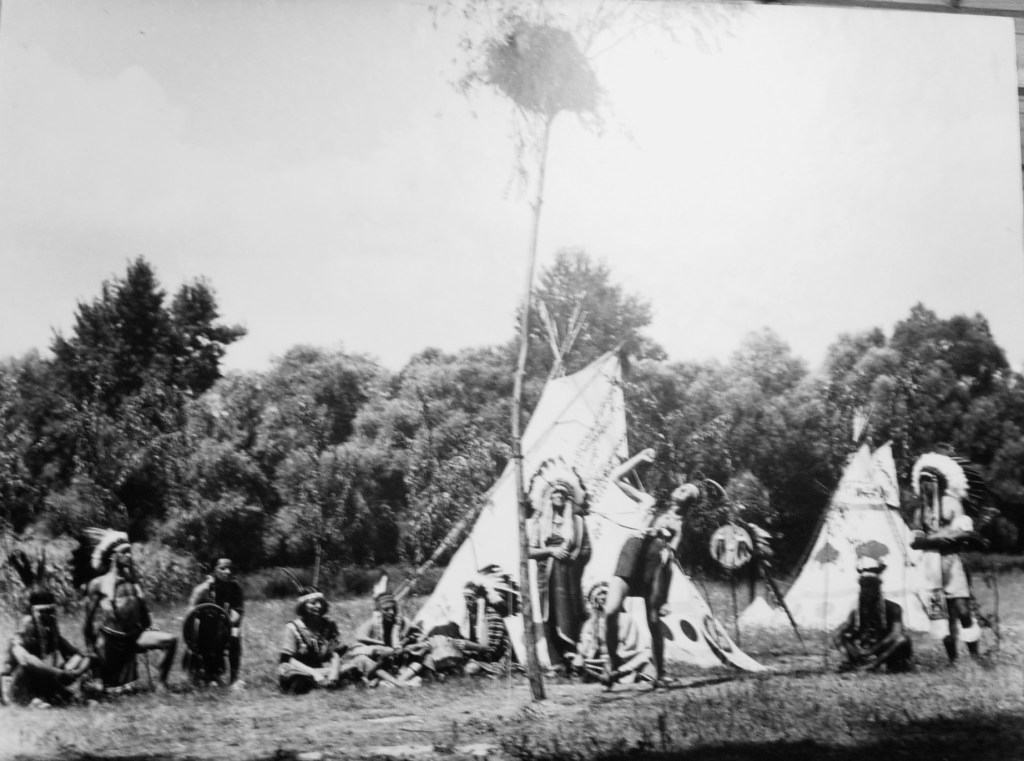


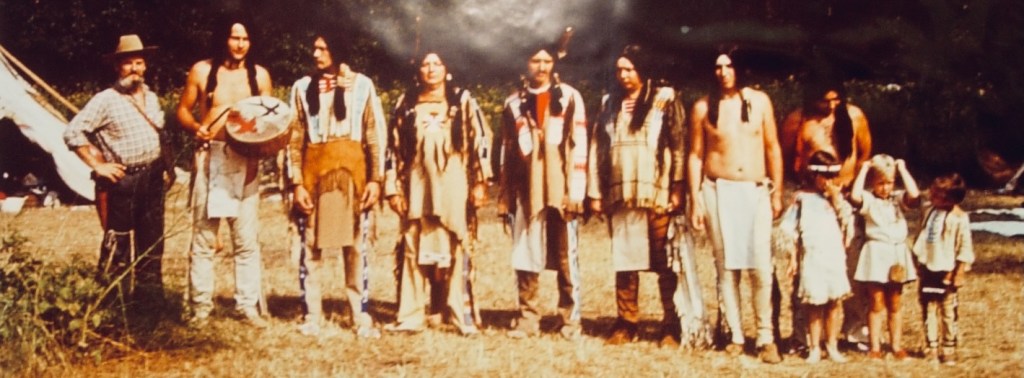

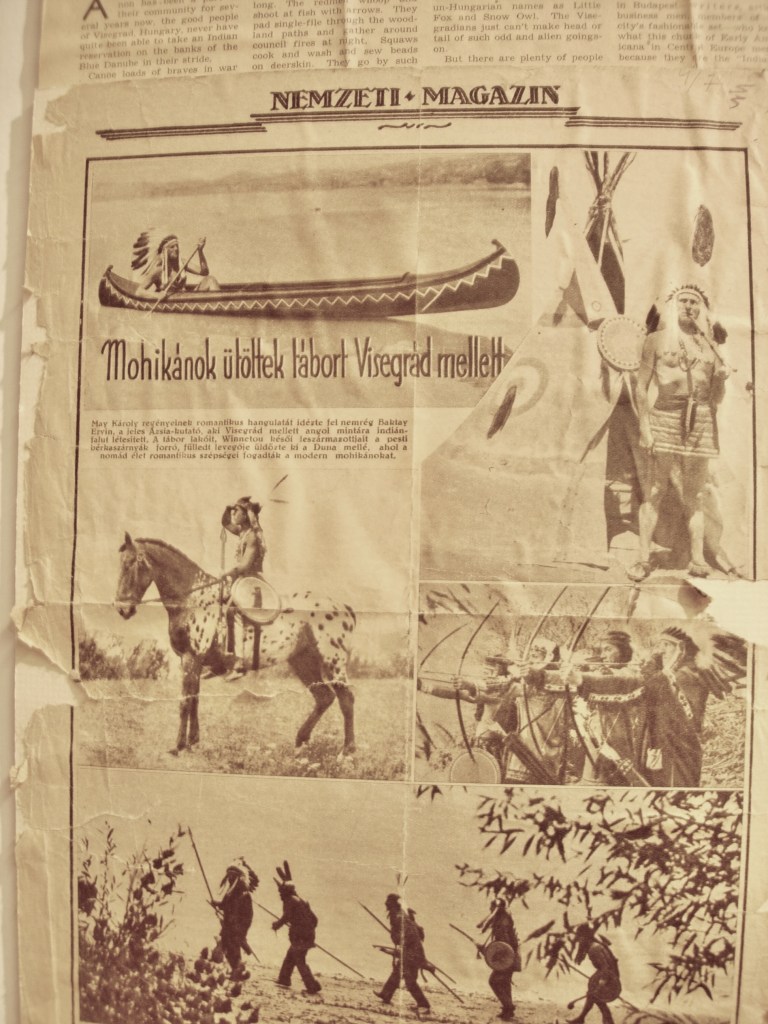
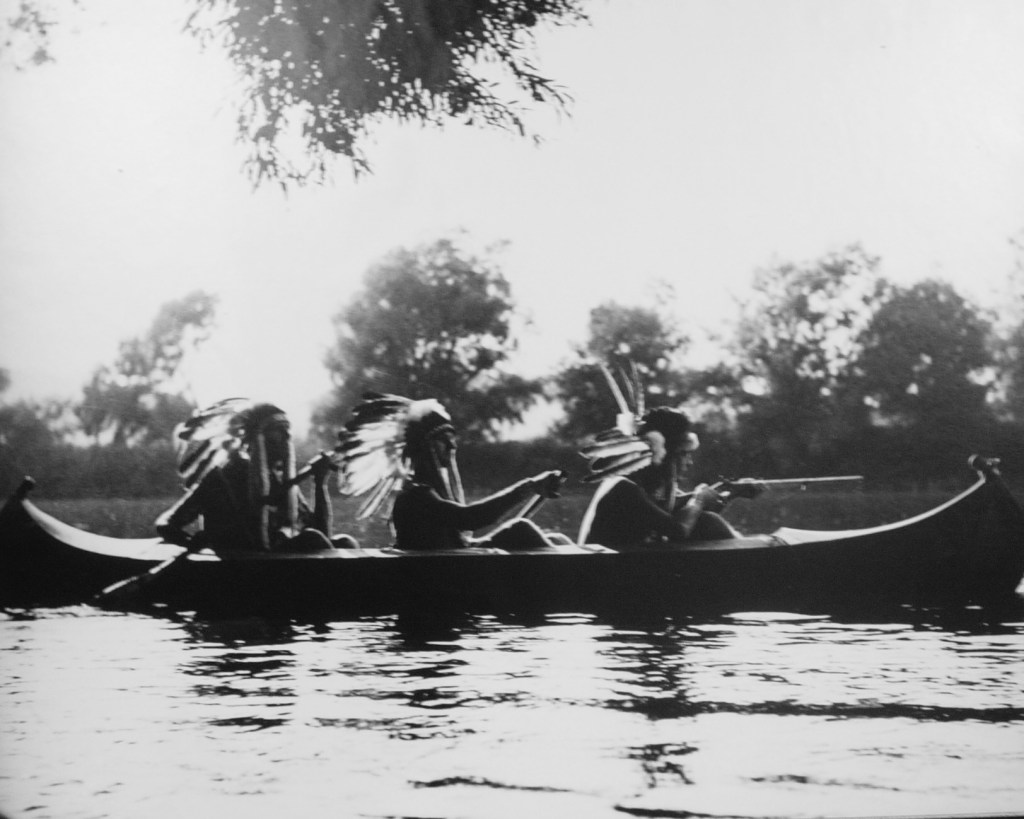
The escalators lifted me into the gray – a relentless, cold, bitter, snow-washed gray. Neither majestic nor cool but dirty and corrupt. A merciless, unkind, infinitesimal gray that climbed from the ground and stamped down from the sky, that clung along the Danube and pinned thousands of souls to the earth, spat in their faces and poisoned their eyes. No matter if sprayed with revolutionary red or patriotic blue, the relentless gray wiped away history with oppression and hopelessness that only a mix of brandy, tobacco and violence could numb.
I killed time in the cold stench of the underpass, firm that I was part of a cultural collision, here to encounter the shreds of what was left and what it created.
Two Romani musicians cloaked in camel hair coats grumbled at their violins as the trams creaked above us. They took turns smoking near the stairs. I gave up and felt my way through the gray to a nearby jazz club. I wanted to talk to the soul whisperer who trained me how to keep on the straight and narrow.
“Either you get a good horse and a bad instructor or a bad horse with a good instructor,” he said after I’d spilled my guts of things I did or thought.
“Time won’t go backward,” he assured me.
I celebrated the verdict, fortified myself with a sticky Guinness before crossing the bleak, frozen Danube. The tram nosed like a sick rat along the icy corridor of the Tabán, once an entertainment district and then a bombing alley, spiced with the corpses of allies or invaders or their own, who were aptly named depending on the twists and turns of Hungarian revanchism. Ideally, I was prioritizing questions and collating historical evidence for traces of Buffalo Bill and his European tour of 1906, especially six weeks spent threading the borders of Habsburg empire.
Áron’s building was next to the Continental Hotel – playful socialist architecture with a Bauhaus touch smothered in ivy, moss and smog on Buda’s flats.
I was imprudent and decided not to spoil the meeting with photography or video; I was to build trust rather than record. Secretly I was mad with cool about a wicked afternoon exploring the footnotes of history, in this case when a tiny group of Hungarians portrayed themselves not as Huns but as Native Americans. It was the ultimate compliment, an act of cultural appropriation or even a conversation among continents of the oppressed.
Áron appeared on the landing. White hair swept back. White beard. Silver bolo. Faded textile shirt. The door was a tight entrance for the two of us.
“I like your kucsma,” he said, nodding at the pelt of black lamb towering over my brow.
“Ah, it’s from Transylvania,” I was quick to point out. I’d forgotten I looked like a cartoon.
“Have you been there much?”
“To Kolozsvár and Márosvasárhély and many spots between. I had a friend there, and she helped me track down Buffalo Bill’s route – which led me here.”
I wrestled off my coat, ditched the hat, then entered through the parlor to which I’ve been directed, two rooms in one, a few beams exposed as if to make it homely.
A woman rose.
“My wife,” he said.
“Hello ma’am,” I replied.
We stared admiringly at one another.
“Coffee?”
“Oh yes, please,” I said, knowing that the pensioners would produce a turgid, chicory-tasting water that required the utmost politeness to swallow. On the wall that doubled as a shrine I spotted a sad pair of rifle replicas (Winchester and Sharps) and a shellacked stump in the shape of a longhorn. We settled in a study decorated with a handful of Frederic Remington reproductions, a few lounging Romani odalisques among them, on the mohair couch. Manila envelopes mulched on the writing table and mushroomed photographs that held their breath for explanation.
“It all began with Ervin Baktay, who was born in 1890. Baktay became a researcher, and he had a relative in America who sent him the cowboy magazine, West. They organized ‘Zree’ parties in the early 1930s, first along the lines of toga parties, for their artist and bohemian friends, and then they thought why not have a Western ball, around 1931. They did some research and prepared that winter.
“They posed for a photographer against a Wells Fargo backdrop as sheriffs, dudes and bandits, cowboys, gunslingers and the tragic smiling gals who kept their company, in vests and ten-gallon hats. They played cards, drank, square-danced to fiddles, and sang at the piano.
“But what were they going to do in summer? Why be Indians! The first Indian summer camp was in 1931 in Zebegény6 for two months. They had three main chiefs to keep order. They built the first traditional canoe in Hungary. Some people just came for the weekend.
“It was a lark, the girls in polka-dot dresses and the men bare-chested and wearing war paint for target practice.
“During the day it was not obligatory to dress like an Indian, but in the evening, around the campfire, it was mandatory. People could play two roles without too much trouble.
“That site was deemed to be too civilized. Housing and farming encroached on their camp, and they moved to Kísmáros Island until the Second World War, when the island submerged due to the building of flood control dikes along the Danube and to better navigation.
“There also was a break because the camps ceased in 1943. It wasn’t until 1948 that they resumed. They didn’t harass us. But they checked up on us.
“It was wonderful. The river was calm and had little branches everywhere.”
Áron began at the age of six in 1938, introduced by his relatives. Then the camp moved to Kisoroszi after the war until the construction of water works.
“I know them. I like it there,” I said.
“That was our place.”
“What was the inspiration, was it Cooper’s Bőrharisnya (Leatherstocking)?”7
“Well, yes, Cooper and May’s Winnetou later.”
“What was your motivation?”
“Entertainment. For example, in 1937 we shot a short film, A sápát árcú varázsló [The pale-faced medicine man], and in the 1960s we made camp newsreels. We enjoyed what we did.”
He shuffled the photographs from the envelopes, a strange facsimile of totems, fires, lodges, smoking, singing, squaws, braves, horses, cattle, infants, papoose, moccasins, head dresses of eagle, turkey and ostrich feather, beading, teepees, saloons, the Börzsöny hills in the background. The table cascaded these private images of Eastern Europe’s mysterious river Indians.
“We were maritime engineers, and we worked in Óbuda and Népsziget, so the Danube was part of our lives. Our children have kept the traditions we started along the river. We never went to an üdülő or any typical summer retreat. We made sure not to miss our time in Kisoroszi, it was sacred and our annual camp went on for a long time. Our kids grew up there. We wanted to isolate ourselves.”
“We were not persecuted but they knew everything about us,”8 added his wife as I registered the toffee brown coffee.
“They didn’t harass us. But they checked up,” he said.
“The play Apacsok by Ferenc Török talks about that. What was it really like?”
“They did inform on us,” she affirmed. “Sometimes the river cops came round.”
Being a member of the Hungarian Indian movement seemed like a risky, pro-American gesture at the time, about as bad as being a jazz musician. I sensed how much they had fallen in love with their community along the Danube.
“There were two different camps at Kisoroszi, two generations. We had a reunion in the 1980s, and Tamás Cseh9 came from Bakony, but we didn’t know much about them. We only knew about the Germans and their rendezvouses.”
“There was no one to teach us,” Aron explained. “There were no other friends or guests other than Buffalo Bill the Second in 1963. He was English and took the stage as Buffalo Bill as part of a Swedish circus. The second act in the show was Buffalo Bill with his acrobat, Elsa Lisa. He was a great guy, and we became friends. He could shoot. Let me show you.”
Aron scooped up his library of disks. Soon we were spinning into the grainy black and white vortex of underexposed eight-millimeter. There she was Elsa, spinning from silk, ribbon. Bill soon entered on his white charger. He’s got the right hair and beard. Not a bad reenactment. He engaged in trick shooting, a damsel hostage scenario, stagecoach attack, naturally with great horsemanship at the one-ringed Big Top in Budapest’s city park. It was 1963, and it might as well have been 1906.
He dug deeper in his files and screened the camp newsreels. He’s got them all, including footage of a melodrama from 1937 shot on a strange nine-millimeter format, a melodrama with a quack and an assorted cast straight from the bill of entertainment at Fort Laramie, Wyoming on the blessed Fourth, mimicking drunkenness, violence and savagery, though with a sweet, homemade ad-hoc touch.
I talked of my research in the interlude, showed him some snapshots of Scout’s Rest, Bill’s home in Nebraska up to a certain moment in his chequered personal life.
“You don’t happen to have anything from the 1906 tour?” I asked.
The program was in tatters. Bits were shedding from its edges. The paper was degraded. It needed proper care, but I flipped through it anyway, like a Holy Grail.

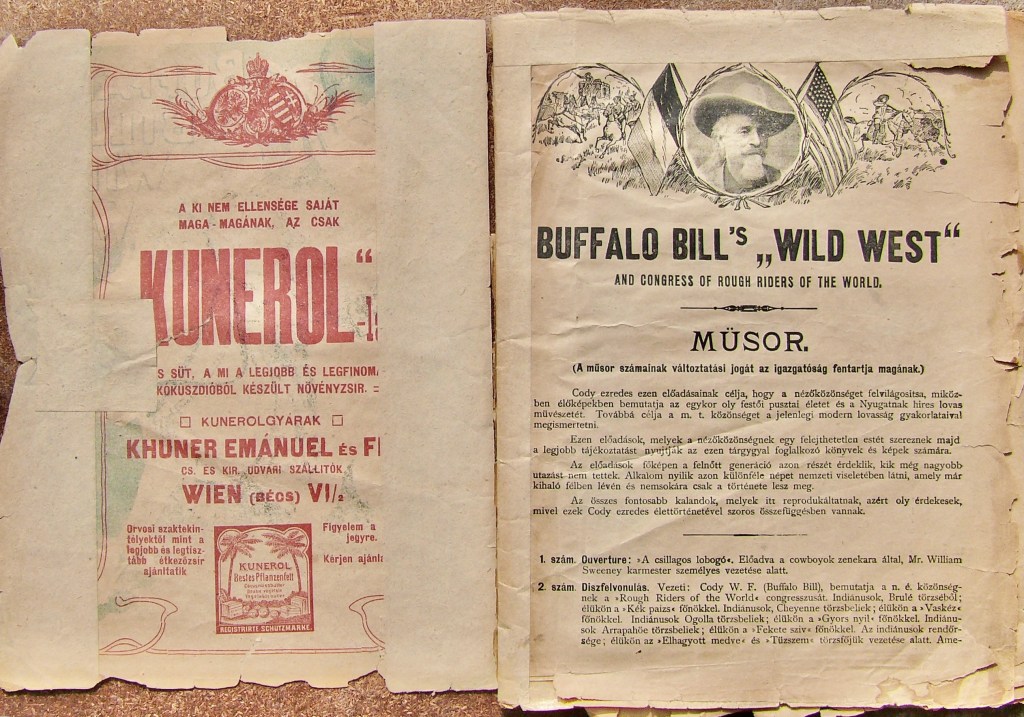


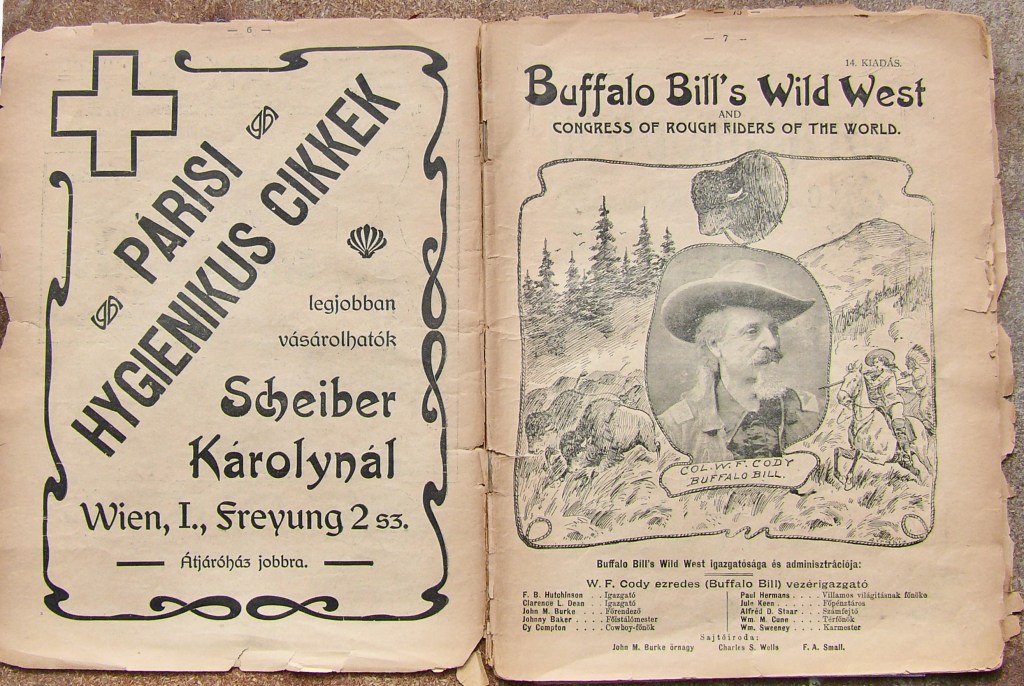


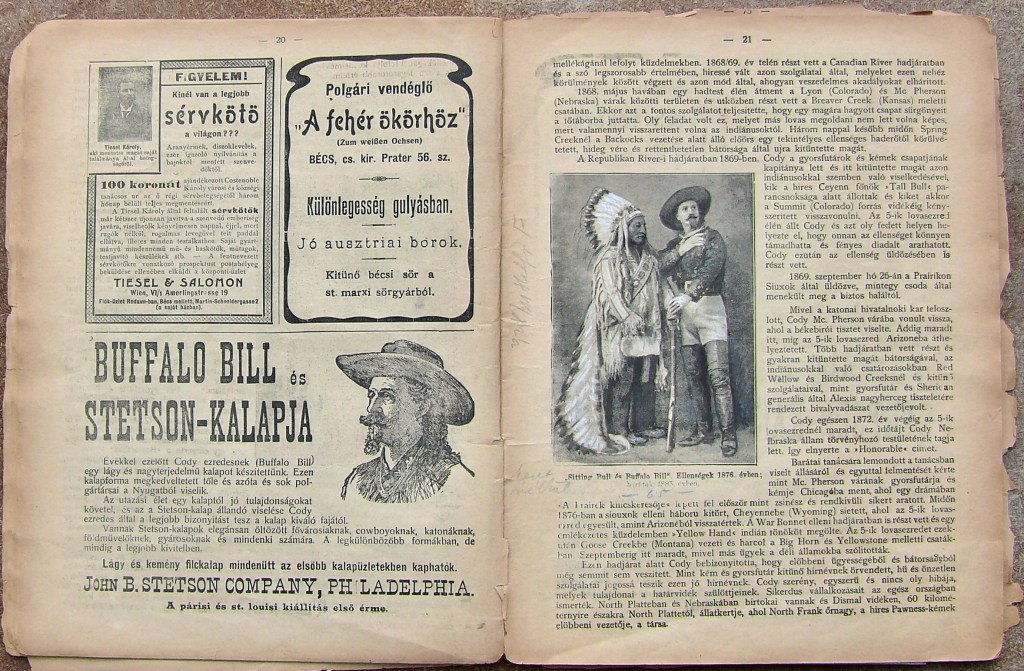

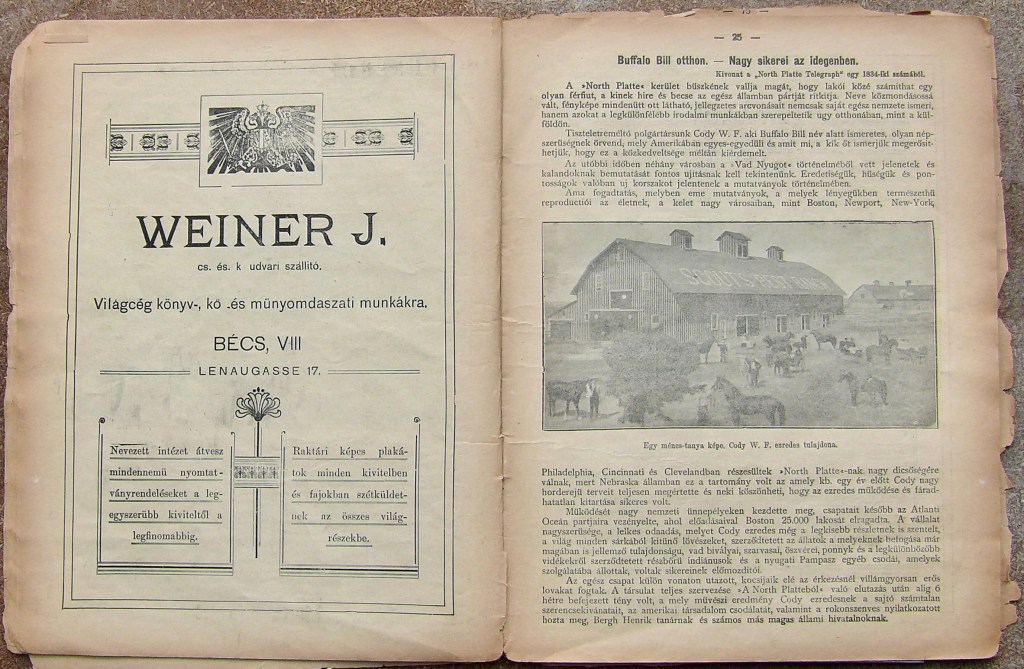


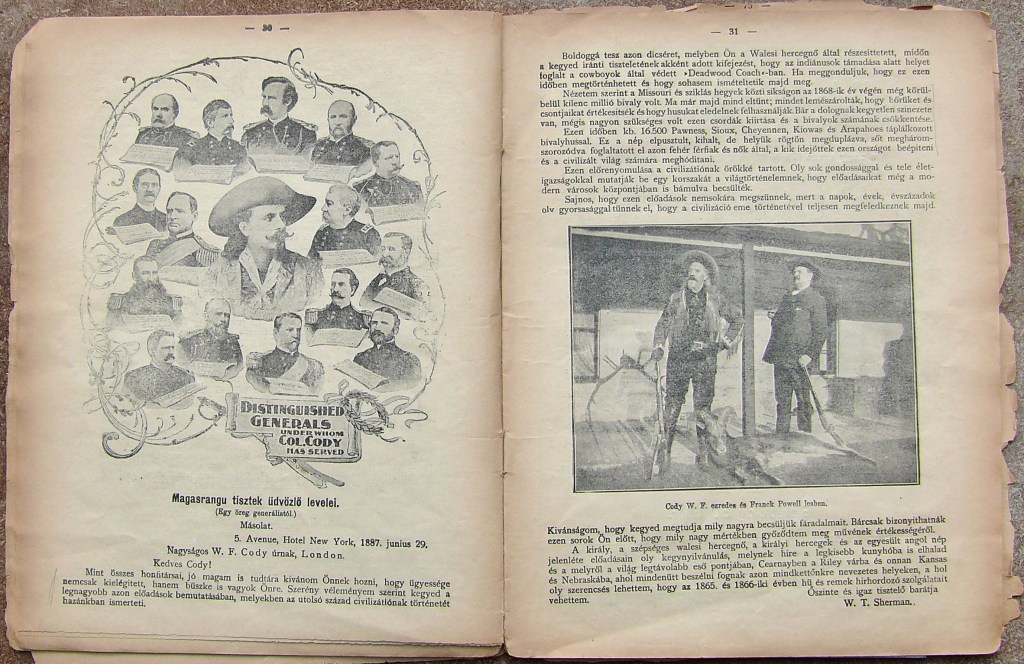
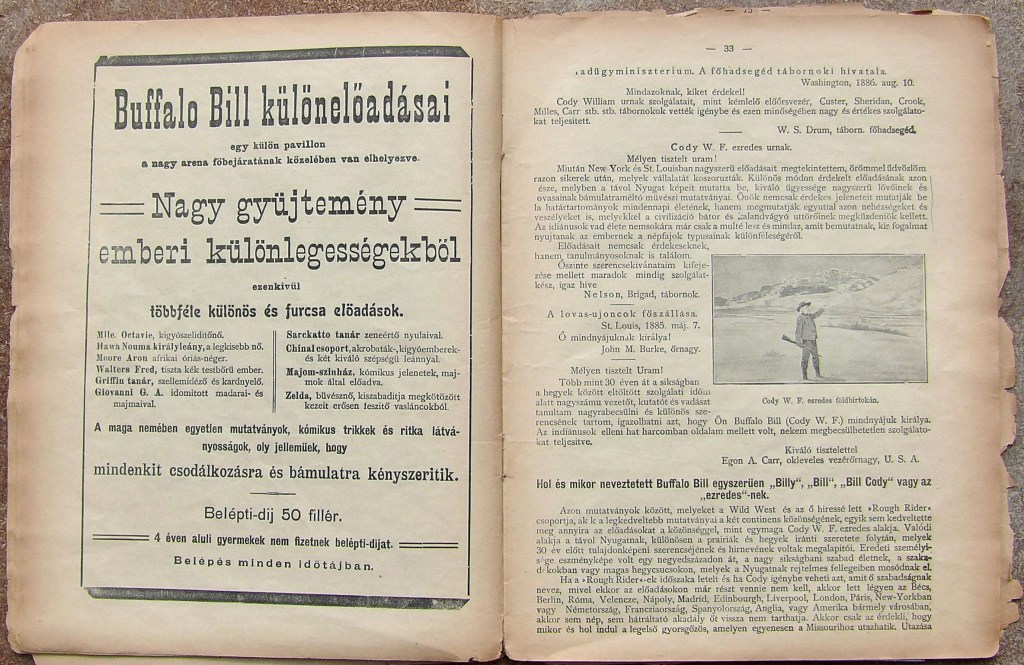

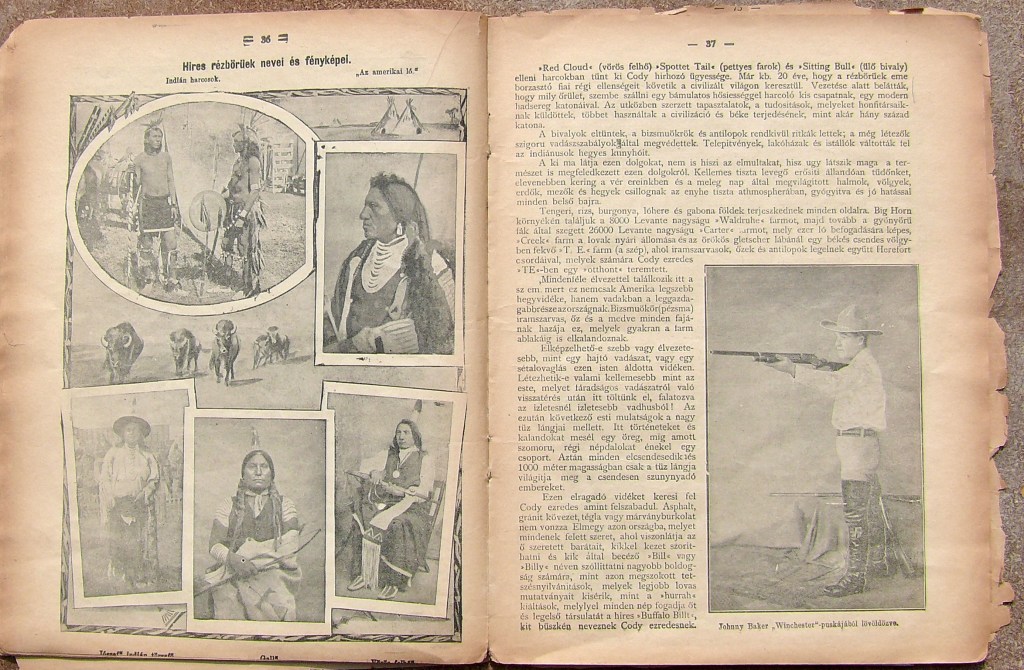
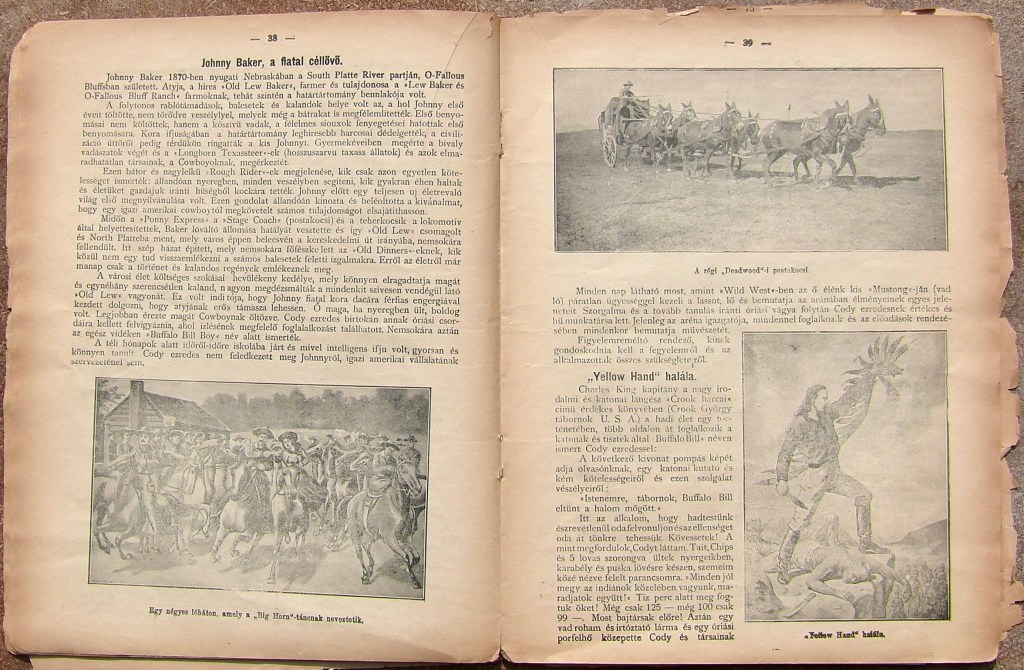

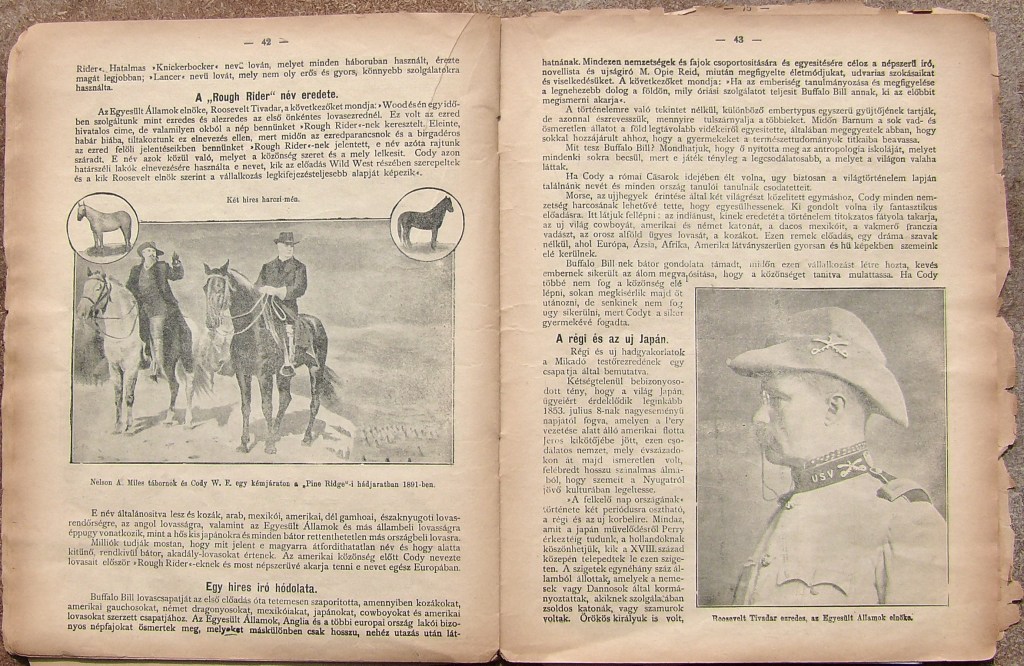
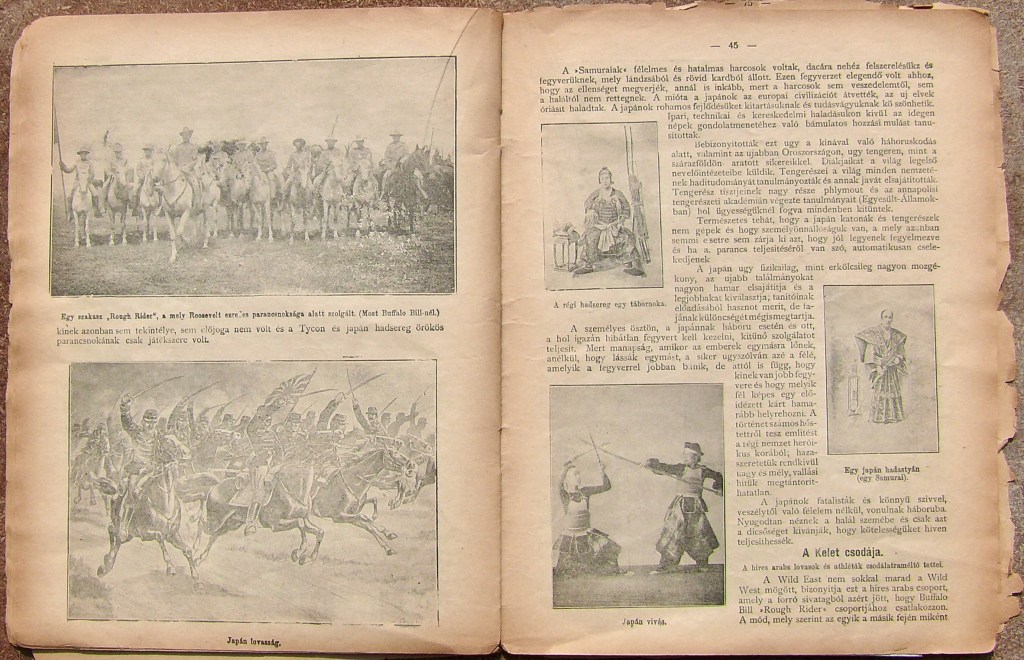


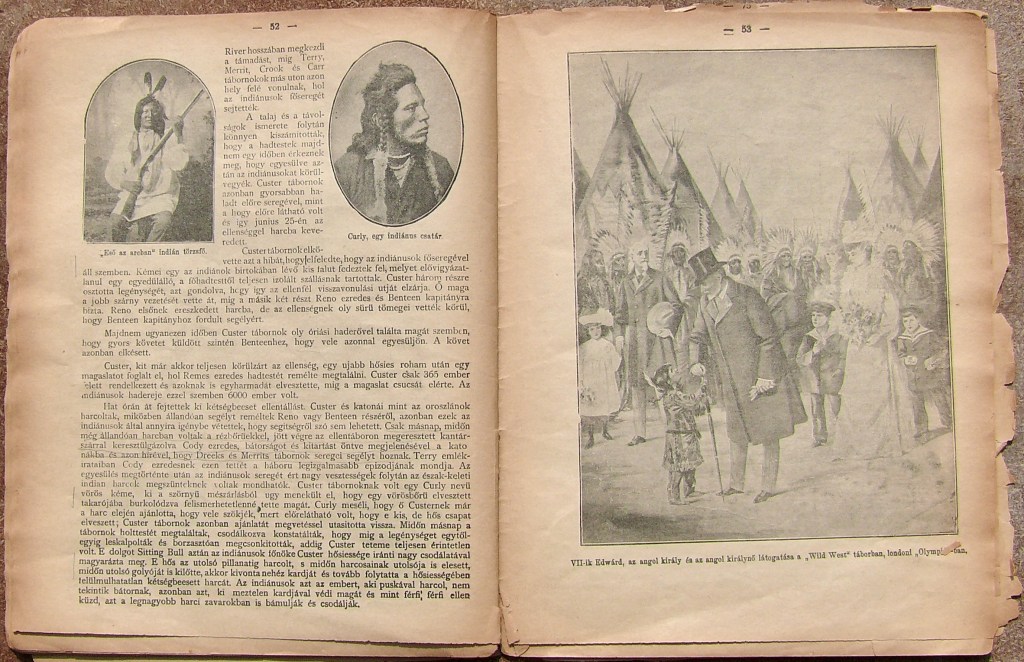
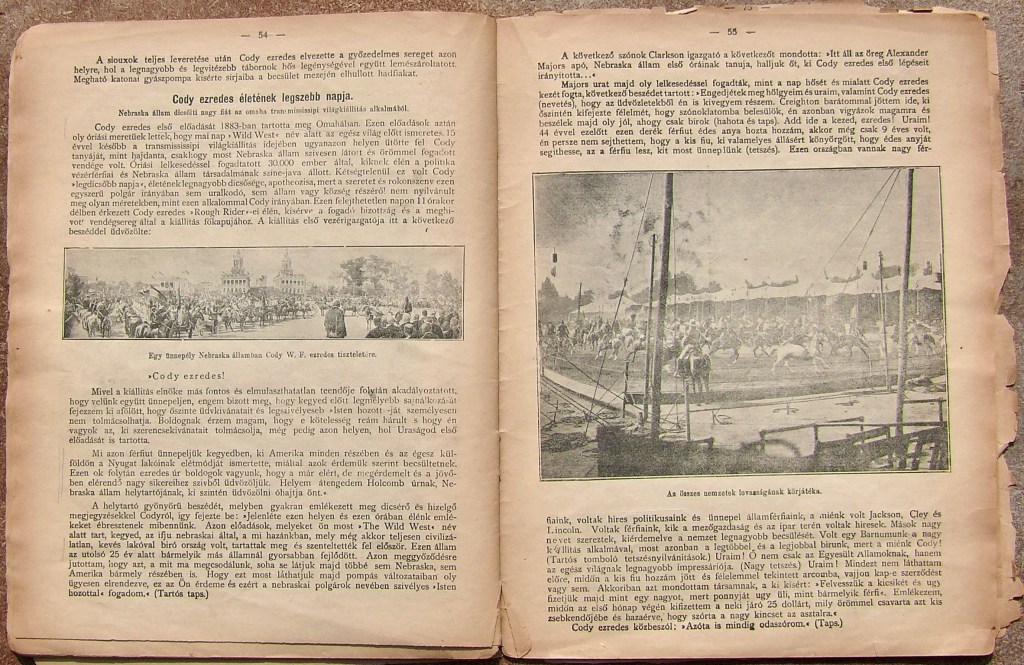

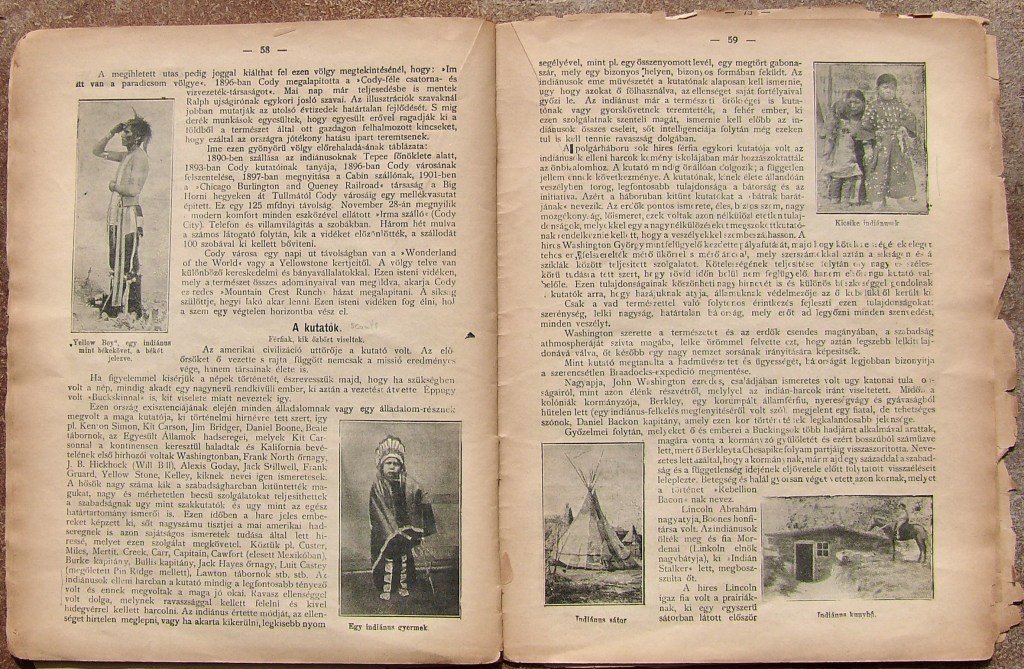


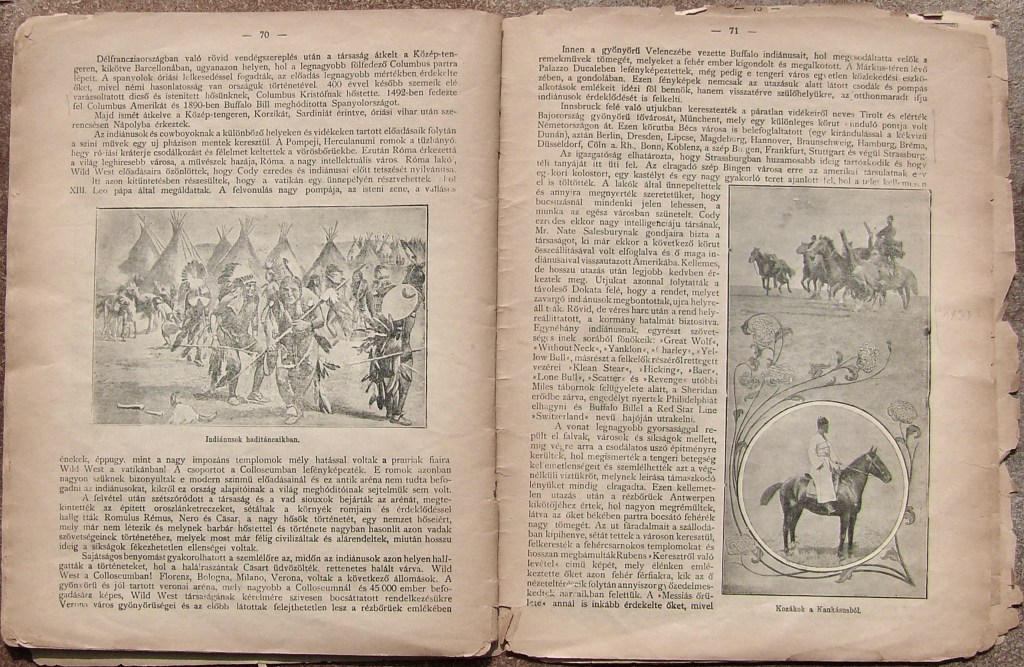

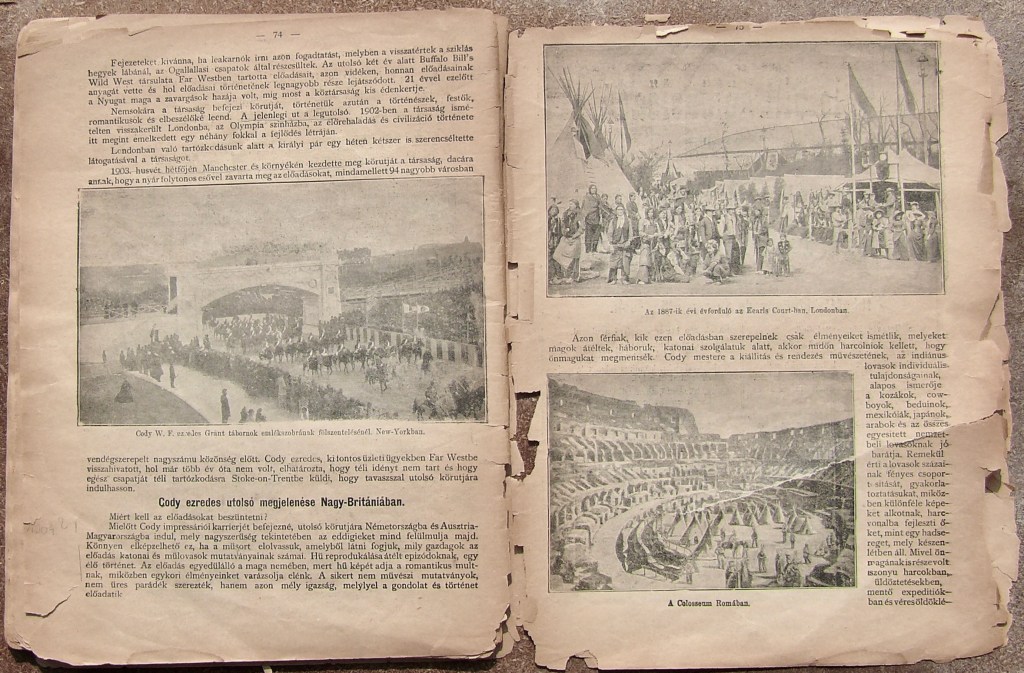
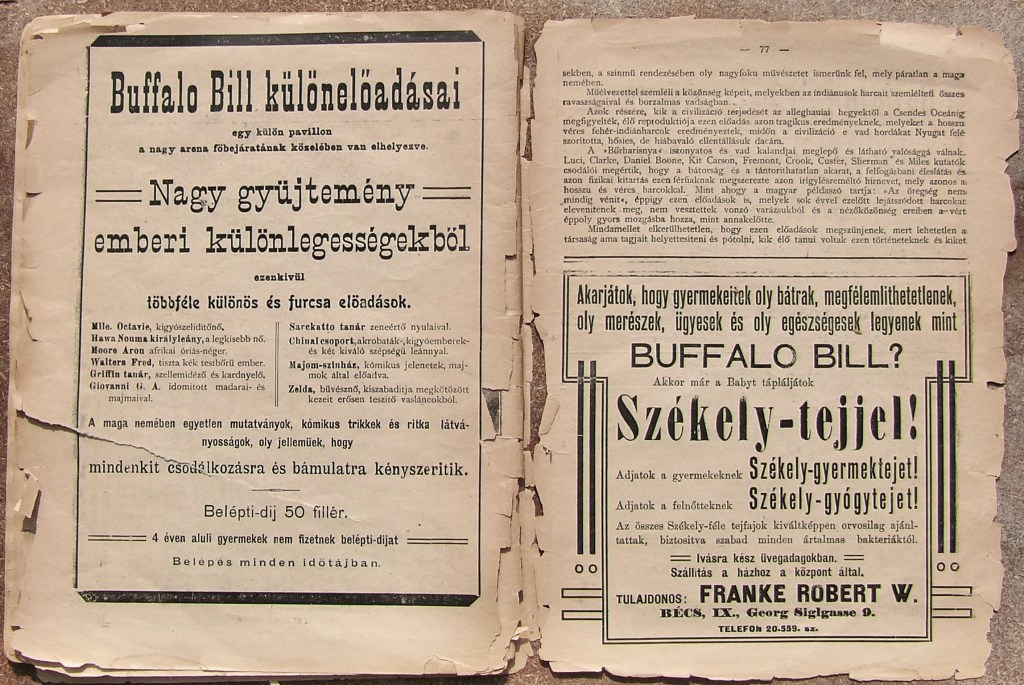
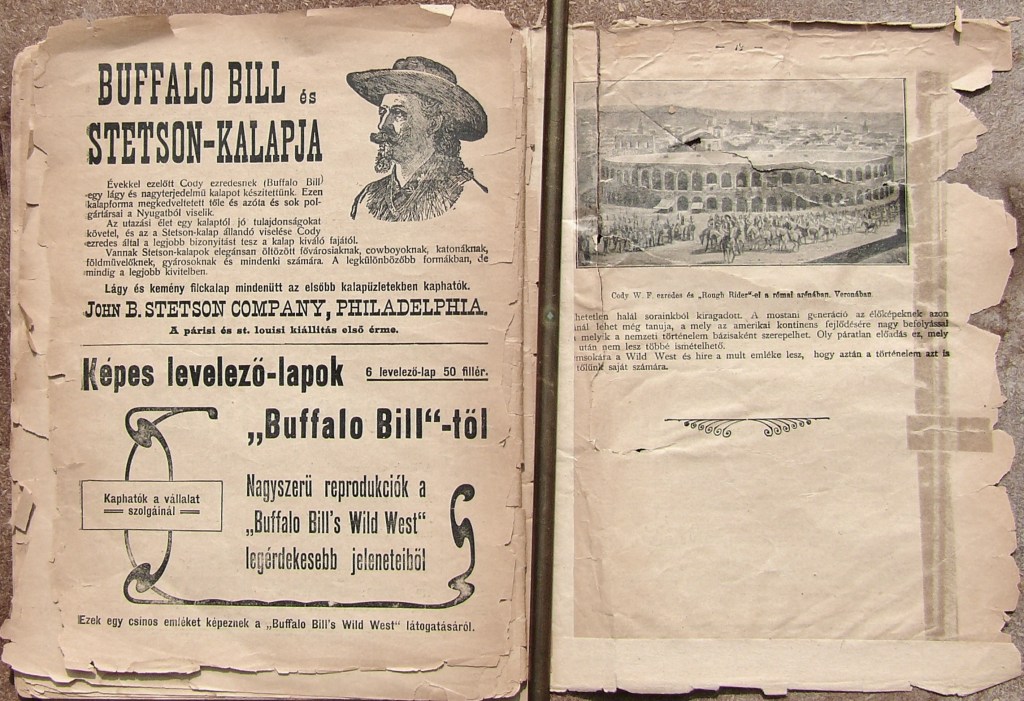

“Anyone else have one of these?” I asked.
“No,” he said, “I got it from Baktay. I’ve never seen another one.”
Bill’s program was littered with local advertisements for a thriving community of confectioners, liverymen, hoteliers, merchants, grocers, tailors licensed bill posters, hay, grain, and mill feed, signage, bakers. And the agents also placed ads for steamship companies, collected by the agents preceding the show.
At this point I tried to explain how Bill was part of the collective consciousness in a city like Glasgow, thanks to lots of shows and a statue in his name.
“You’d never know he’d ever been, even after a fortnight in Budapest, three weeks in Vienna, and so many spots in between,” I argued.
European wars and ideologies had swallowed up the American cowboys and expunged them from popular culture, and to be fair they had their own cavalries to contend with, the same ones who exhibited in the show, global acts from Argentina, India and Japan. Yet somehow this naïve band of Hungarian Indians camping and canoeing on the Danube had survived intact.
Áron finished by taking me through his country music, mostly Dolly, Hank, Kris and Willie. “We didn’t listen to music at the camp,” he emphasized. “We weren’t that political either. We were there for the nature.”
He won’t part with the program – how my soul longed for this relic – but he copied the films instead.
I was being disingenuous when I asked him to help me find Sastoll, aka József Lorenz, in Kisoroszi, for further research.
Some months before I had pedaled from the city and met József at his museum in Kisoroszi on the tip of Szentendre Island, not with a repeat encounter with a mystic lip-pierced dwarf who zipped on his scooter along the Duna, his sunglasses pulled down and his Mohawk sprayed up. On that foggy day I was supposed to be walking with my fellow translators in the hills, but this mission took priority, an excuse to go fast and solo thirty miles upriver. Getting there demanded energy and pace, along with hazelnut, steak and parsley sandwiches and a bottle of tea.
I found the room on the top floor of the town’s culture house. The museum was cared for by a sprightly older man. He wore a straw Stetson and answered to the name Sastoll or Eaglefeather, and he didn’t show up right away. No one was there at first except two buckskin, tasseled mannikins with braids, displayed among a canoe, a few pairs of boots and a lasso, a Stetson dated to 1928, some ragged beaded eagle feathers, and a certificate of appreciation from an American Indian group – they had copied the lazy stitch (eight beads to a stitch). Some members had visited the United States or Canada and returned with porcupine quills.
He jangled his keys and said he was closing when he arrived, but he became more friendly once I explained where I came from and why I was there. He was extremely tan from a lifetime among the natural environment of the Danube, paddling its pebble and sand beaches, hunting its flood plains, sloughs and bays, a labyrinth of possibilities away from the prying eyes of the state.
Everyone who I had found was far too young to be a witness to the tour of 1906. But Baktay and others had, and whether thanks to Cooper or dime novels or American cultural diplomacy, taken to the Indian way. And for his disciples, the river camps became an important kernel for resistance and preservation of ways of life threatened by modernization, urbanization, collectivization and the ultimate power of the state as the world shifted from frivolous playground to social engineering. At least until power was turned on its head – temporarily.
I dared not mention museums and collections I’d seen in comparison to this flimsy room or describe green hog backs with wind and water gaps, the grass chest high, the sun leading to Montana, then over the Bighorns, foggy as we picked our way over, heading past the ranches to Cody.
I didn’t have enough breath left to talk much further with Eaglefeather that day.
When I pushed down the poplar avenue, I was intent on the long stretch home before dark as the sun dashed into my eyes through the trees. My mind traveled into the past that was the present, just 300 miles apart, a world of traditions, heritage and transhumance, where once shepherds have returned their summer pastured herds to their owners, the autumnal market can commence, a great burbling mass of languages, goods, sellers, collectors, browsing among the closets of history spilled onto the grass. Their shapes could be apples, knives, antique books, remnants bound and found, things from a time before there was immediacy, when stories traveled over and through time, glyphs over a motif of textile, print made of threads, strokes of a needle and woven out in minutes.
My swag bag filled as I searched the market at Black Lake. I disappeared among the objects and their halos of names and words, thirstily gazing at millions of objects resting on the ground, displayed on plastic or canvas, hanging from a fence or spreading on cars, dangling, floating, suspended in disbelief that it’s departing and arriving in a flash of a hand and money in a palm. Yes, that day was strewn with followers like me looting the windfall of a great army that finds profit in death. Our belongings were cast under the tents of the shoe sellers, hills of clothes as if an entire people had undressed and vanished, danced naked into the sooty river, and drifted away never to come back, or if they had, then speaking another language, the dusty air peppered with argot when I brushed to the front of a violin and synth band in a lantern-lit yellow and blue marquee in order to be alive and not yet history.
Stands
Europe 1906 season for Buffalo Bill’s Wild West and Congress of Rough Riders of the World
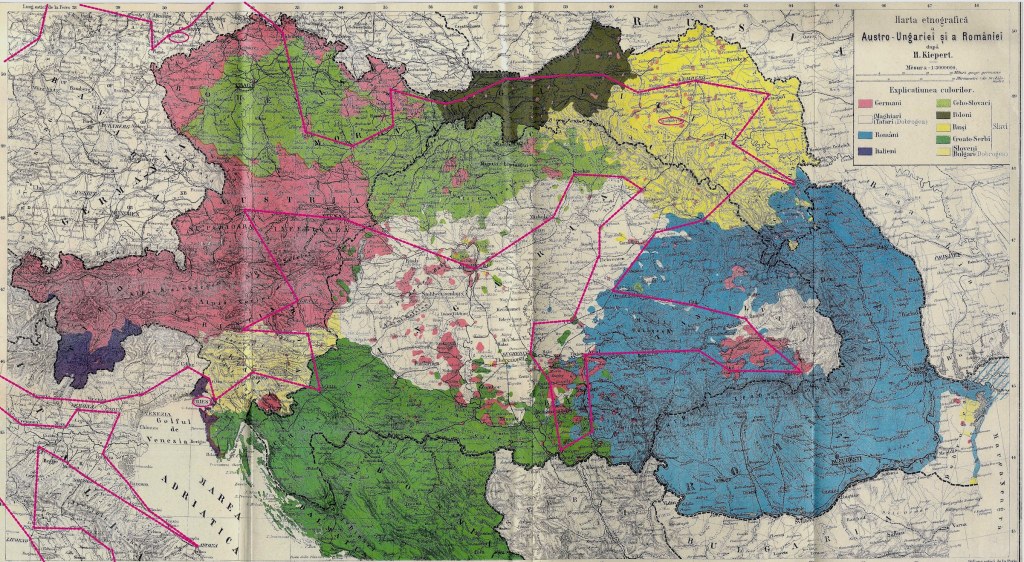
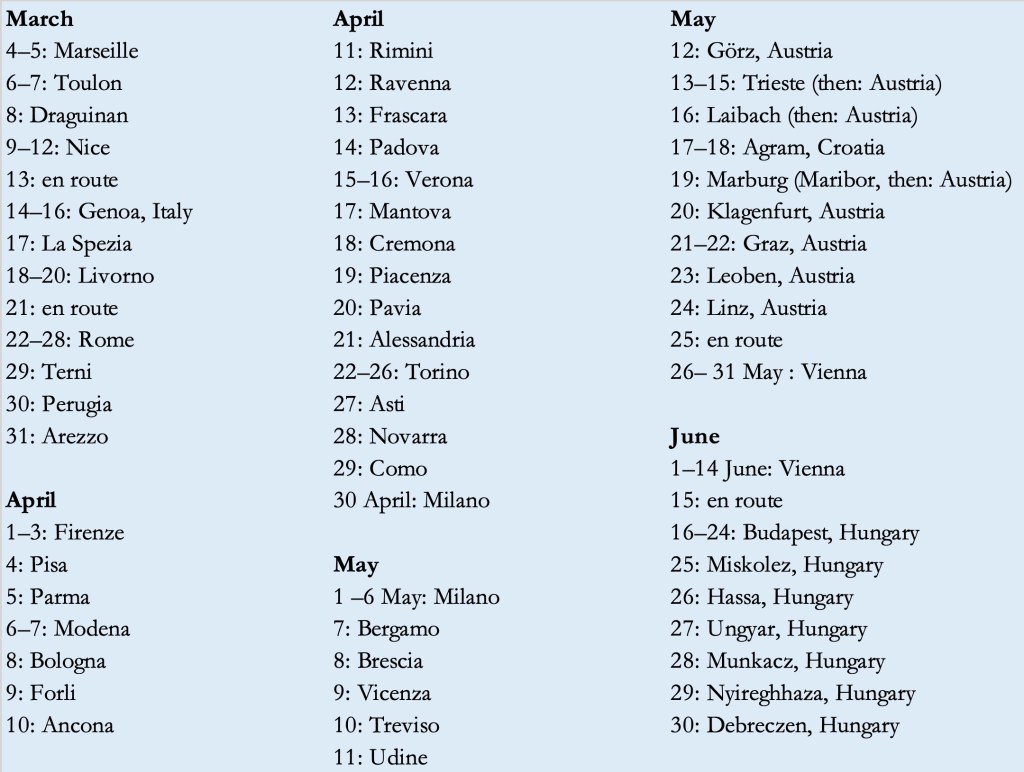
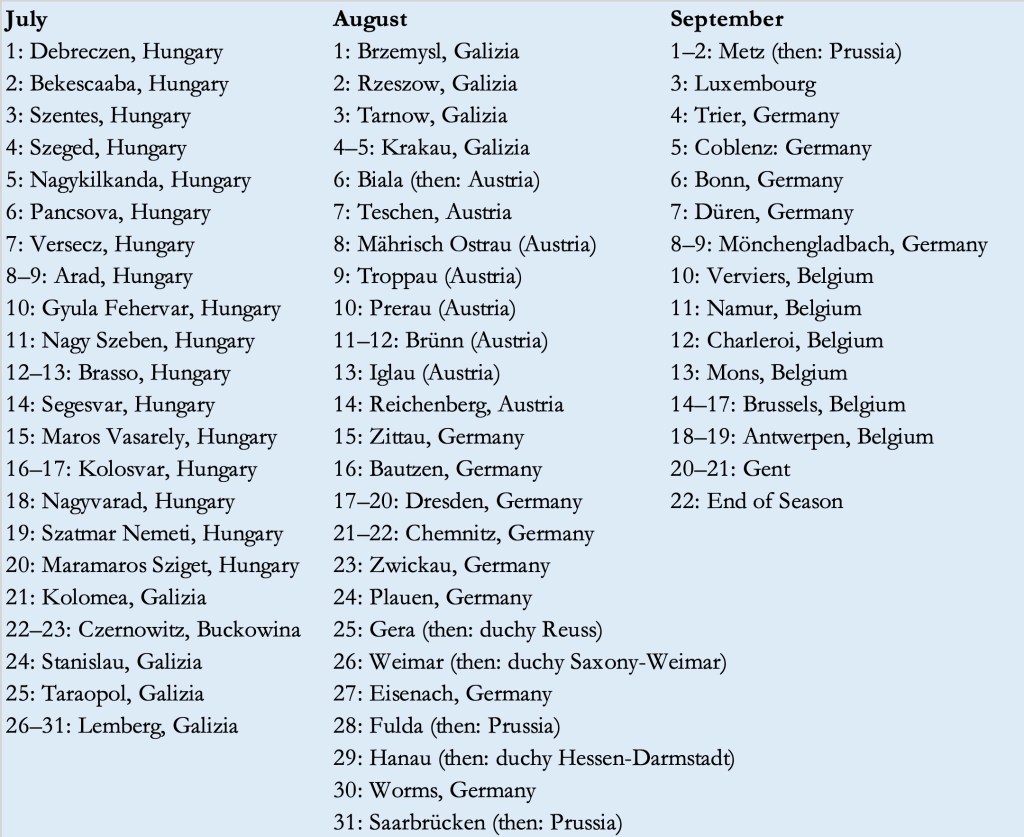
Xtreme East
Relays and remixes


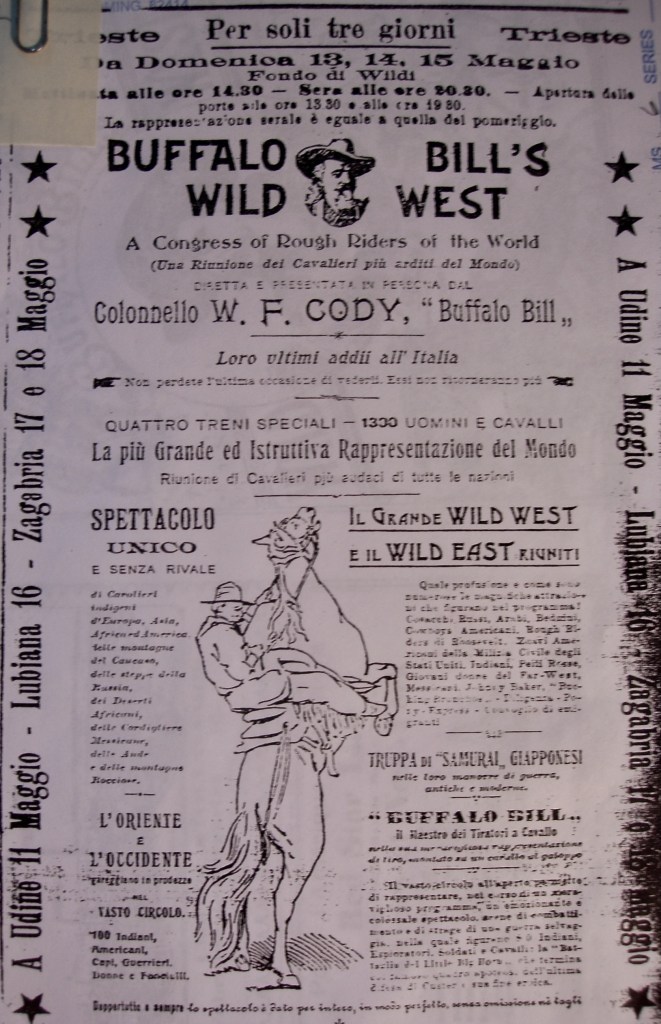


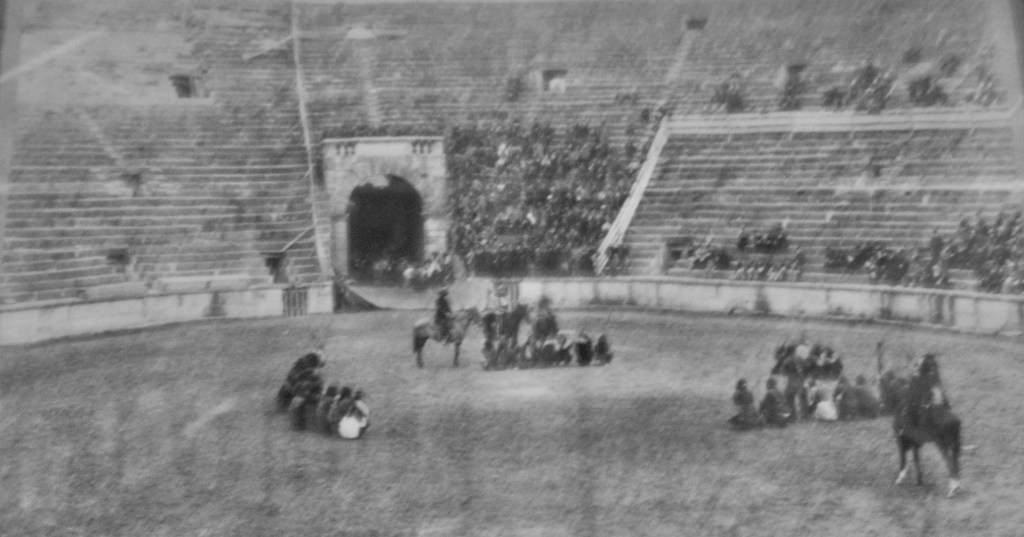
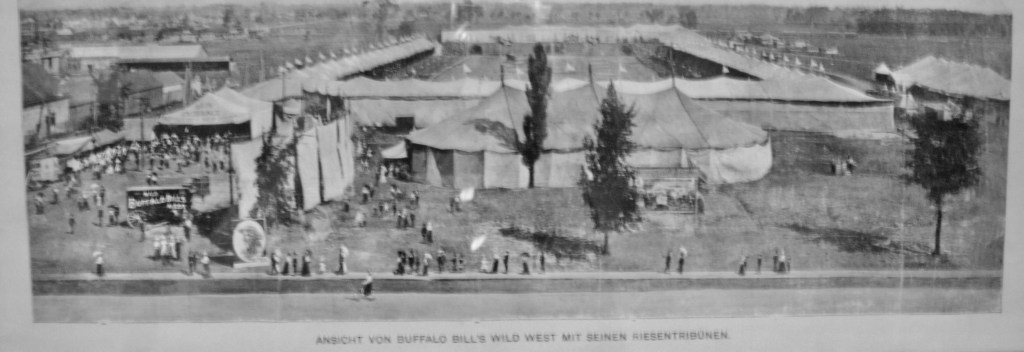
Trieste, May 13–15
It was his last night in Italy. But he wasn’t sure about that either. It seemed Italian even if it wasn’t strictly Italian. At some point weren’t we all Italians?
Bill couldn’t tell and didn’t know.
He set his wig aside after the matinee. He shut the door to his trailer and wandered away from the fairgrounds, coated in hysterical lights and minced by organ-grinder music. You could chow, drink, sleep or go whoring, so long as you were back for the show. Every now and then he took time off from his coffin-like quarters, and today he had to retrace his steps.
Where exactly had he staggered into town and then ended up on the waterfront again?
The seagulls skimmed the surface of the harbor and the wharves rattled in the distance, barges being loaded like the one swinging in, big and close, and then vanishing from view past the kiosk bar where he was now, pondering those missteps from the morning, the town caught unaware of the arrival of his three trains that he had arrived, drunk and hungry.
Customers sat under the sun umbrellas, their conveyances parked in a neat row. He was on shank’s pony, and he had a habit of wandering off, well, riding off, because his legs were too bowed to do much else.
He wanted to be gone because he wanted to know the slant of the land, just being gone, absent for a while to cool his heels for a moment, code for a refreshing beer or some of that apricot and gneiss flavored juice the Germans love.
Yeah, Riesling, especially from Mosel.
He wasn’t the main act all the time and he’d trouble accepting that.
The waiter pushed on him a shot of rye, grape apparently, and it stunned him with its raw grace. What he’d picked up in Italian couldn’t express his shock at the gift, a discovery really, of what fruit was for. Certainly not eating from a bowl.
He hadn’t bothered to change his wardrobe and was still stitched into his buckskins like a bullfighter. And he had the cape.
“You big fat dope, you think you’re some kind fool?” he said, berating only himself.
The best thing was to do nothing at all, he’d learned that, but it didn’t make up for the fact he couldn’t understand quite what he was sitting around for in a wicker armchair, plumped in cushions, a little ottoman for his swollen feet. He didn’t have to act anymore. That made sense.
It was out of the way, under the high-tension powerlines that fed the city and port. A couple were necking, and the others were eating fry bread brushed with garlic and a goose feather, basic pizza, which he’d acquired a taste for, begrudgingly, certainly not hominy grits.
The water churned and sparkled. He should be going back. He didn’t leave forever. It was only a little inopportune, disrespectful mostly, of what the others were doing.
“You’re doing it AT them, not WITH them, you idiot,” he said.
He’d thought plenty about it, but he felt such a deep pain at not being at Scout’s Rest.
Out of the way but popular with the motorcycle with the buckskin tassels, a tattooed sunburned guy with an afflicted walk brought cups of wine to the Italian guests, dressed up proper, brave older men and young companions, all ruby and blush.
They had civilization but he had progress. It was as if they’d kept the beauties out of Nebraska and locked them all up here, at this seaside café, where he, with supreme difficulty, managed to remove his feet and jut them onto the warm concrete. Even if he’d tried to bring a wife out to the great land lung, they hadn’t intended to stay and went home to suitable towns like this, all polished stone and motes of lights swimming like fish though the passages.
Bill was unsure where he was or what he had been doing. He could hear the band clamoring away. He was sure they’d done the parade earlier? Or had he been sitting there since then? Had he met the dignitaries or not?
Already, the show was merging into one continual journey that he seemed to have no control of. He was not the pilot but merely the passenger. He was booked along the old trunk lines and junctions of Europe, following the commerce of the old iron horse built with cold-blooded labor.
He felt he had to find out where he’d been all this time. He flickered like a hologram when he stood up, as if it was too much for him, and he did waver but then coalesced into something as he stood up and got tangled in his coat and struggled with the notes. He noticed a big group of eccentric women with cropped hair and kohl under their eyes.
“Bit ahead of your time, aren’t you dears,” he said. “But then again so was I.”
Bill staggered off promising to revisit this infernal puzzle, he hoped in the right direction, toward the clamor of the show, the cracking of bullwhips, yeehaws, hiyas and sharp brass bringing a cheer and glee that seemed out of whack with the melancholic beauty of the irises and peonies that lined the beds at the edge of the parade ground, now mangled by his cattle and crew. No, no he wouldn’t be back but conveyed to the next town in his private quarters, what’s left of a bottle of that fruit brandy tucked under his head.
Not that sleep stopped his thoughts.
A man had pulled him aside after the show. “I’m Aron” he said, “My friends call me Italo.”
Bill slipped the resin ball from his pouch and tossed it, sighted and fired. He could hit it with a puff of air and it’d disperse, so delicate was its making.
He had buckshot instead and it did the job expertly.
When did he start looking and when did he become Bill?
Cold, windy, strangely bitter wet drops washed off the sea and condensed on the edge of his hat.
That must have been when he set off.
Zagreb, May 17–18
They were heading inland. The smell of sea that had jogged along for much of the journey as they had rubbed along the Italian archipelago was gone, vanished into what he regarded as kinder and homely, the smell of pasture, pollen, manure and insects. He had headed for it like a thirsty heifer.
It seemed normal to crawl up to the highest point, the vanguard of the town if coming like all invaders from the east, not the civilizers from the west who marched through the gates where he and his haphazard band had been presented the key to the city by the bald fat mayor, all mouth, gut and buttock, accompanied not by his own musicians, but those of the town, a strange orchestra of throat singing that reminded him of war cries.
He was no stranger to native music; he heard it whistle in the wind holding up kites on the knoll of a hill below
The people looked happy at the airfield that guarded Bagram with their own flying cavalry. They frolicked with their dogs or ran, clutching their hats and the pockets of their waistcoats. He studied the bluffs with nice runs for skis and sleds and he could imagine the frosty joy of so many people like beetles running from their burrows in the summer meadows.
The shoots were aromatic and springy, clusters of lilac and yellow and white that he sat upon, cross-legged as he drew on his pipe.
Good eatin’, he said, to the corsage of petals he had arranged in his smooth hands.
A beagle’s deep hollow bark ricocheted through the trees.
On the way he found a grove and inhaled the freshly felled larch and pines. He put a ball of resin, an opal of sunlight, on his tongue and felt it stick to the roof of his mouth. The taste would be there for hours.
Some kids were squawking in an old gravel pit.
It’s boring that way, said a passerby.
He nodded and thought about how to get back.
The bridge over the Sava stank of smog as the sun fell over the castle and the hills like sentinels. The spans bucked underneath, his boots and spurs tinkling. It wasn’t much of a river and it certainly wasn’t much of a bridge.
A plain woman approached him in the botanic garden. “Sir, would you like sex?
“Romance?” he asked.
“No, sex,” she replied, to which he felt sympathy and a larger amount of horror.
Poor girl. He was no stranger to floosies, especially when they had charm, cool and were undeniably cute.
This wasn’t the case.
The sun was falling, gold and red like rain, red rain on the red earth of where he had rested and pushed off his body, a star, pushed so only his heel and shoulder blades remained almost levitating, like he’s seen Houdini do, too, jettisoned above the crowd.
Kind of.
They were both still in their prime.
He wandered under the girders of the station, humped like bread. Or buffalo.
People washed at the fountain and crickets sang. Tired lagging footsteps, squeaking trolleys, last trust in an agreement of conversation before separation. Ah, separation, of that he knew and it was more often that his hellos were farewells.
There was a crumbled telegram in the pocket of his jacket and he crumpled it up again.
The walls of the old town had been knocked and scratched by the bullock carts.
Maribor, May 19
The poplars bowed along the lake. They were fresh and green and full of promise. He couldn’t distinguish its shape, other than it was long and a few islands were scattered in the distance among the mountains, jagged crumbling creatures bunched up together like they were cold
He unlaced his shirt, slipped off his jacket, loosened his belt, let out his belly, straightened his posture and breathed in, stretching a spine compressed by the jag of horses and the thump of the saddle.
He stood on the point and the wind was hot and fresh and he lifted his arms and stretched, his feet planted in the ground and the balance in his toes, for once, was equitable and he could feel the current surging through him.
He was adamant: no retainers, no handlers, no entourage. And people mostly left him alone except for the odd fan wanting an autograph on a piece of memorabilia.
The park gendarme didn’t flinch when Bill unsealed his flask and necked a drink, and he compensated in not looking by staring, and since he had no one to report to, noted aloud the crank in the feather-struck hat and brown leather suit like a ghost, all burned red in outline against the sun so that he was bleached of color, bowing and warring with his supple shadow.
He’d come to horses in a backhand way.
Hockey. Rollerblades. BMX. Pump tracks. Skating. Freestyle. Downhill. Trials. Then dirt bikes. Then stuck on bikes as they got closer to resembling motocross anyway. All that time, with so few sponsors for his klutz-like riding, for it was accidents for which he was world-class, a series of breakneck jobs speaking French, Spanish or German in the kitchens of Europe that he’d had since the age of 14 when he left his foster mother and gave it a shot, making his own home by his own hand.
It wasn’t all stunts but a lot of hard knocks and improvised solutions to injuries and motors and gear alike. It was duct tape that held him together.
He’d had to do it for a part. He auditioned in Prague for Robinhood. He reigned in with three other riders, the soundman poked in his boom, the director shouted action, the horses jumped and kicked, and he said his lines with such certitude that it seemed like he was eating prairie chickens again.
And it clicked. Bro, did it ever. A cinch that earned a great dime. What was stopping him from mixing extreme sports, rodeo and sharpshooting, something he could brush up on since popping rabbits with his grannie in the town dump.
He’d been running, running from North Platte, his monument erected right against the highway, casting his shadow over the river, taller than the water tower, taller than the … hotel/tenement downtown and even the vast switching yard of the railroad, a legend who had left the town to his wife and relocated to the edge of Yellowstone, with its stream of millionaires taking in the good life at his hotel before being led into the majesty of the caldera.
There they were, on the edge of two time zones, neither central nor mountain. Reconfigured into an hour early or an hour late, especially due west at Lake McNaughty, its color not that much different from the aquamarine of Lake Bled upon which he gazed, slowly getting the kinks out of his body, the wind light and searing him with a welcoming warmth, the warmth of the male interior, not the sterility of what he regarded as a female sea.
He knew what he wanted as warrior. He was waiting and he would strike and he would not lose. Smelling the wild carnation and clover and buttercup that exuded from the earth, he also felt the strength welling out of it. That very same dirt that had allowed him to allude capture so many times. Flying contraptions buzzed the airfield, some man aloft in a great kite, pedaling it seemed, a Scot they said approvingly, the velocity of the little craft jotting over the periphery of his eye as he gazed skyward, bending and exhaling and turning himself into knots. There was a sheep pen, and he was on the watch for ticks as the cricket began to sing in the wonderful lawn, his leg tucked under his knee, knowing that as he made warriors, he was one, he was ready, yes, that he was the main attraction and that the show was his, his by God.
The line manager suggested the auditions. “Gee, Bill, don’t you know I reserve the right to decide what goes in.”
It was about time he had rights.
The little newspaper man, a vole really, cuddly but quite nasty and utterly weird, made sure the appointment to discuss the future of the show would be late, when Bill was soaked, and he had an edge. He would manage the risk of Bill’s irascibility. All he needed was to be liquored up.
Klagenfurt, May 20
Two girls were waiting on the platform. They looked exhausted. One had a bunch of moles bringing from her neck, almost an albino he thought. But the other was cuter, darker, cooler, obviously the one who thought she was in charge.
“We didn’t get a ride to Venice,” they said.
Oh, we’re coming from there. Nice place, he said.
Is it far? they asked? It’s taken us an awfully long time to get here. We had to abandon the autobahn because we couldn’t get a ride and we were so tired we came to sleep in the railway station.”
Ah, he said. God, they were like tired mice.
“And they’re all thieves this time of night,” said the big one.
“You can stay in our camp in you like,” he said. “It’s not far off the trunk line.”
“What?” they asked. They talked among themselves in a language that was so garbled that he thought it to be African, if African was a language.
Or was his speech that was so mixed up? And his thoughts?
Was that the fountain in the square that was gurgling?
They thought they’d be his equal or better. There was nothing to fear walking down the unlit lines of the railyard bunched in against the town, lots of its redundant track reabsorbed, the roads and airport more important
He looked old in the grainy light. Indeed, the light seemed filtered, crisper, sharper, distributed, voided,
Graz, May 21–22
He hardly woke for the show, could hardly bunny-hop and now he found himself late at night, wherever he was taken, to a beer garden or fair, he couldn’t tell which, not knowing quite where his keys, his wallet or his senses were; he balled his fist around his beer and took a drink as he watched the crowd.
Garlic and fat flowed off the grills of pork cutlets and kebabs. Red and white lights sparkled over the fairground. In a tent was a settled crowd listening to two long-haired Romani singers in black accompanied by man playing a box, and two other musicians playing guitar and cello. It was low key, slow, but the woman with hair plaited to her waist did a slow twisting hip-churning dance.
They twirled the hems of their skirts, and their hands were free, chests open, underarms exposed, and he felt fiery and excited like he was in Spain again, holed up in a cave against the heat. He recognized the strange off-beat melodies and the half-steps like an out of tune player piano, in holes of timing he would never agree to in the ring, even when it was the breakbeats of whatever country rap they’d figure out —Billy Rae or Vanilla—for him to shake his ass too while he was somersaulting 175 yards through the air on the back of his bike, having descended a jump of similar height. Anyway, he was as cool as shit or so he thought. Well said.
But they had class, the Spanish, hunting for hares with dogs and allowing about anything so long as it was hedonistic and you managed to breath the next day.
Her hair was like a tent. She slapped her hips and curled and flicked her hands.
A nervous blonde paced next to him, along with some hideous creature (her mother?), who had no teeth. Indeed, why smile if you had only the weakest of ivories, just a peg or two?
Yes, he shaped the show, and he’d seen this kind of thing but what was the magic – boy meets girl? Likewise, love? No yes well yes no, it was something that annealed to his eye, like biting sand flies.
He missed the brass and one of his hands got onstage, a Basque kid, if he recalled right from the 300 or so performers in the show, and the kid knew when to raise his horn, and as odd as it seemed, knew when to add what were like cuts, brief beats, accents, a phrase. What started hesitantly was soon more confident, like arriving at your own hearth. One danced only, the other sang, clapped. She was the force that held it all together, like Annie O, and he heard everything that it was and is, primitive and civilized, sneaking up on him like a well-dressed bobcat, ultimately what would eat him and it was magic, the light strange between the trees and the conversation rebounding off the leaves, people animated, excited, those that had seen the matinee, shelled even more for the evening show, gotten hungry in the meantime and bought from the canteen and bought a souvenir to get signed backstage. The crowd clapped and whistled for entertainment because it was rare anyone coming to Carinthia or Styria – either place seemed like the home of Charon – as rare as smiles in Austria, well, certainly if you weren’t rich. These were exactly the people he was with too often, coddled, perfected, protected, out of touch, completely cut off by social obligations to shoot, hung, bully, foxtrot, gamble and philander, the latter of which he was hoping to be introduced, indeed trying to outdo. There was no point in following in their wake. Everyone was satiated and didn’t want to spend a cent more on popular entertainment no matter the feats of illusion. Well, not enough to make it profitable for the prices that they charged
Circus de Luna had poached some of the best acrobats. Russians (Armenians actually, stocky people who could all punch above their own weight). Chinese (he loved the vase juggling). The Senegalese (who had a sort of monkey circus that preyed on people’s prejudices). They were all now working for Luna’s many ongoing shows, having signed the contracts that Luna’s scouts kept at hand.
Luna had succeeded in a way with lighting and stage design that Buffalo Bill and the Congress of Rough Riders did not. While Luna looked exceptional and professional, they looked threadbare and amateurish.
So, they had to look for more talent as they went on, sell their promises to which there often were takers, if not skeptical ones but that were susceptible to Ned and Bill’s praise. Empty living quarters and a half program were not going to earn them any favors with the public.
At half past noon, three hours before the matinee, two quite small people knocked on the door of Bill’s trailer. He was drunk, drowsy and belligerent, about to fall asleep.
“Yeah!” he said.
They pulled back the screen door and ducked their heads into the mess. It was pungent of tobacco and sweat.
“We’re here to audition, Mr. Cody,” they said. “Mr Ned sent us.”
“Not now,” he drawled. “Later.”
“It would suit us, sir.”
There was no point in being a complete jerk. “What you got in mind?” Bill looked at the pair and he wanted to hug them, they were so cute, like imps or children or midgets, he wasn’t sure, but they were cute, the one blonde with a hooked nose and a gaunt red face and the other as if a sibling, but a shaved head and a little cheroot poking from his mouth. They were quite tidy and there was an air of great knowledge about them, as if they guarded a secret. That they both had wands did not dispel his sense of wonder.
“You’ve heard of Tesla?” they asked.
“Why no,” he said. “Who’s that.”
“Kind of a guru,” they said. “Like Edison. An inventor.”
“Guru? I’m not having any of that boloney.”
“No, Mr. Cody, he was a scientist!”
“Ah!” said Bill. “And?”
“He made electric coils, and we can make them too, but better, kind of.”
“So?”
“How are we supposed to answer that,” they said. “You’re very blunt.”
“Am I?”
“What if we were to audition this evening?”
“Why not just join the show?” He noticed there was a strange greenish glow about them, as if lightning was about to strike, when all the air is charged and ready to explode.
“No, no,” they said. “We’re too well known in Graz. But we can help you out. We’re dying to make our show public. You are on tour?”
“We need performers. Did Ned send you here?”
“Saw us this morning.”
“Nothing?”
“He wasn’t impressed.”
“Ned wants to think he’s in control. And he won’t take anything he can’t sell. He’s a bigger drunk than me.”
The two little people looked at one another disconcertedly. Maybe this wasn’t the kind of entertainment they should join but something far more sinister.
He auditions the radio static dwarves. They insisted on making him a cage for his mount. And he paraded around the coil and half a million volts of what they called plasma draped over him like a cascade. It was a touchy maneuver, and he was shaky today, worn out from the suds that seemed not quite as good as he would have liked.
He wasn’t James Brown, but he had the same policy. He fined every one of his performers for being late, out of tune, off cue or poorly executing any line or act at the huddle after the show when all the performers discussed the dynamics of the night.
He didn’t particularly like the goatee dyed white or the long white hair that rubbed his shoulders but that was the part. Mixing bicycles, guns and livestock wasn’t exactly his idea either but it worked well enough.
He was too sensitive for this line of work, all slang, bravado, physicality and daring do. Maybe because he was so intelligent that it made it easy. He didn’t want to let on that he was smart. Wise, well, maybe. That could be acceptable.
He let them underestimate him, even if he was the main attraction. Did they know he had an agenda?
He was offered cowboy coffee, but they made it better and let the grouts settle. It didn’t taste burnt and over-percolated. It had a roundness he wasn’t used to.
Linz, May 24
The country was dry. It hadn’t rained all spring. The gardens seemed asleep, dozing, their heads hung low, grain, fruit, cabbages, all wicked of moisture and thirsty and growing tougher and scrawnier and thinner by the day. If it kept on this way, the only thing to grow would be grapes because they could take almost anything.
He didn’t notice in the cities like Linz. Everything looked fine: fountains flowing, produce in the stores, people moving about as if they were not in jeopardy, which they were, of depleted harvests and not enough to go around. It didn’t seem to bother them, but it bothered him, and he wished he had enough room for a stockpile in his trailer.
Unlikely.
It was a mess in there and it wouldn’t fit.
Clothes abandoned on chair backs and the floor, fan letters and validated tickets scattered across the table, pamphlets of past and upcoming tourist attractions, belts all hanging from a row of termite eaten pegs, pillows that doubled as furniture if stacked appropriately, a collection of stools stacked on one another, old fabrics in plastic boxes, buttons snipped off in streets, bottles that he had savored or signed or remembered for some special reason, a whole wall of cables, bags of every sort for shopping, copies from the office of contracts and print-outs about he thought was coming next, medicines packed in shoe boxes, woven blankets spread where there was room, the kitchenette overloaded with dirty dishes that he hardly bothered to push aside when he had a slash and the moldy remains of tinned corn, his favorite staple.
He admired the place, a pretty backdrop of ultramodern and medieval, each negating the other and creating a sanitized Disney-like atmosphere. Yep, Kafka would be ashamed, the ghost at the window of the sanitorium looking enviously at the passing bicycle traffic.
He had to hand it to the Austrians. They were into their bikes and made it simple to shoot around, designated bikeways and utter right to the road. Everyone had to yield. The Italians and French hadn’t made it this good for the alcohol impaired.
There they were, crowded around either edge of the bridges, drinking and smoking like lizards in the sun.
His voice sounded like they’d removed his larynx and re-strung it with unworsted, floppy yarn.
He enjoyed when Ned was out of sight, not watching or monitoring. He’d be in the man’s area and had to watch his every move, for he felt besieged by the urges to start with a drink and flow into everything else that would follow, the bad decisions mostly, and he had to resist wandering up to the refreshment marquee and have them pour him a stein of beer. He’d sit in the shade of an elm that spit its sweet sap from its branches and annoyed him, loosen the string of his tunic, and a tit jumped between his legs, quite eager for the crumbs, and Bill gave himself a remote high-five, down low, too slow, the public address covered for now against the dust or mud. It was like golden heroine for once he started, he couldn’t stop, well, not easily.
Boarding his bicycle, his judgment was impaired, neither the stunt coordinator, the medics nor the mechanics could anticipate what destruction he would inflict upon himself or his bike under the shadow of a cathedral, castle or appropriate monument, anywhere they had got a permit, the press and booking agent traveling together, scouting all their needs in advance, the vanguard a few days ahead of the show. The local sponsors tents would already be up when they arrived: Knorr, Red Bull, Traubi, and the local skate and extreme sports shops.
He was mystified by the term. What was extreme about leaping down a canyon with eight inches of suspension and a parachute for the base jump?
Overdressed in equipment and pads, he missed the simple quality of Ocean Pacific when he was a kid kicking through lots and jumping fences in suburbia, skating pools, ditches and parking garages, anything that required a little balance.
She laughed in her plastic chair and put her hand on his shoulder. Was she Cantonese or Kazakh? It didn’t matter, she was so immediately comfortable. He couldn’t tell, not easily, from this distance other than her long elegant fingers and her cropped hair, just how beautiful she was. She touched the corners of her mouth, grasped her wrists, crossed and uncrossed them, stretched out her fingers.
“It’s the fear in me,” she said, laughing.
He felt so earnest he could read poetry out loud.
He touched her neck and ran his hand down her sternum.
That’s what he imagined. That it was him, not the young guy in bad clothes with bad hair.
However, there were no good and bad choices, just perspective on where he’d been and gone, done, not that he had much recollection anyway and this was what he sought to recall, as simple as the taste of boiled eggs and soldiers, what they’d lived on, the chickens scrambling through the moving camp where he grew up with his Grannie, the mad bitch. They encountered so much prejudice, though bearing little resemblance to Gypsies, but merely their mobility, that they faced rejection in every corner of public life and acted somewhat antisocially as a result (a few well-aimed BBs at the appropriate officials’ dog were Bill’s favorite mode), even having to scatter in the forest to avoid the villagers bent on punishment.
Who else had stolen and sold their grapes along the road?
Oh yes, they had to survive by their wits and cunning
No one was welcome, that was on his countenance as he messed with his bike. Struggled. He left a warrior, was a warrior, was waiting to take what he could, and it was the knowledge of justice that brought him out at night.
His tormentor was ahead of him, by a few days, leaving clues and messages. Panties mostly.
Ah, it was a house of cards, flexible enough but prone to shocks. One well-placed question from the right authorities would send it into disarray.
He hated the poseurs that supposed bikes were more cool than practical.
Okay, his PK Ripper was rad and outfitted with obsessions of lightness, material and craftsmanship. It must be unique. With a LANDING GEAR and TUFF WHEELS.
En Route to Vienna, May 25
He wandered off. He wasn’t there to answer questions or coordinate the pulling down of the tents. It wasn’t his job anyway. He just disappeared. Fuck Ned. He’d felt so besieged by the manager, well, by everyone, that he’d lost his temper with Ned and pounded his fist on the table at his provocation.
I can’t drink, I can’t smoke, I can’t eat, I can’t move. I suppose breathing is next?
His face was inflamed.
The pudgy manager’s constant chuckle that did not betray his depression and worry about the state of Bill and his performance. What kind of cockamamie poppycock was Bill’s new idea? Yes, Ned, like many Czechs had a soft stop for country music and barn dances, but Bill’s accomplishments were, well, dubious, and didn’t exactly guarantee ticket sales.
“Cowboys are out of date, unreal, vestiges, as popular as soldiers, the walking dead, clinging to a world that doesn’t exist anymore Bill, you know that.”
It’s better than what I’m doing now. It’ll be a one hell of rooting tooting show, Ned. Have you ever seen a guy cross dirt jumping and gunfight at the OK Corral?
“Ain’t that biathlon that them poor Norwegians do?”
“That’s skiing,” he said.
“But will it work Bill?” asked Ned.
“Kid, it all comes down to flair, panache and execution, he said. slurring, suddenly not so angry as calmly defending his interests and what he was capable of.”
“Well, get practicing.”
And he was, at least concentrating on what it would look like and what it would be that would lead him to draw mid-air and hit the skeets tossed into the air by his assistants. Maybe he had overcommitted as it would take more than a steady hand.
He looked up at the row of poplar trees. Even if they were prone to desiccating and their crowns breaking, there were so elegant and peaceful, lined along the roads.
Everything had a fresh green ambiance about it. Even if there was drought and he knew, yes, no rain now, but wait until June and July, for which surely the heavens will speak on Saint Medard’s day, thereafter 40 days of rain and wind, the kind that cooled the fields and watered the crops, abating in time for the long hot days of August and the ripening of grape and grain.
Vienna, May 26
The sirens wailed above the city. The streets were washed with an intense, bright light. Even the ideal proportion of green shade and historical preservation could not tame the sun, far greater than any pomp and circumstance the Austrians could invent for their own betterment, self-justification or importance, considering they were a rump state, Germans but not Germany at all. No, the city smelled like defeat and second bests, the sharp bite of piss, alcohol, vomit and feces.
The drunks and junkies were clustered around the Südbahnhof and the performers had been warned: lock their quarters, for valuables were prone to grow legs and walk off. He didn’t like to believe that people were that bad, and he’d lost the key so many times in such circumstances that, fuck it, it was better to leave it open.
He didn’t have anything anyway. Just mementos and a picture of his Gran.
He showered for what seemed like days.
He slipped on his silver and turquoise bracelet. He pulled on his black net gloves. He looked around for clean jockeys. There weren’t in the dinette. Or in the closet. He might have to forego them. He turned over his bed linen and found them there, where he’d kicked the shackles off his feet during the night, wishing for some stable snuggle in which to nestle, an armpit not his own.
He stretched a bit, lowered his chest onto his thighs and stretched out his legs, let himself fall into his battered knees. He pushed his organs, pushed the poison from his liver and his spleen, enjoyed the peace of his nose near his knee. He rose slowly from the waist, stretched on his tiptoes and simultaneously stretched him arms above his head as if he was pushing down the sun, urging the coming of darkness and the chance to drink. He didn’t want any now. Or at least he was vacillating.
He flexed in the mirror. Admired his chest, no sign of the cracked ribs, but one arm was shorter than the other because he had broken the titanium plates of a hardly healed arm in a stunt that seemed to be part of doctor’s orders, broken it so badly that is had stunted and atrophied and made his life easy after six months of worker’s comp. Indeed, when a case of Miller a day and a fistful of painkillers seemed the norm, what any young man would do in his circumstances.
Deep furrows of scars zigzagged across his back, cut into the tattoo of a setting sun, the lip of a canyon and a warrior on a blue horse. Downhill into a grove of saguaro cactus and the flinty desert that had butchered him like meat. That was in the days when even a helmet and gloves was considered a bow/concession to amateurism. They’d amended that with body armor and full-face helmets that made an aneurysm a little less likely.
There was gravel in those legs and arms, pinecones, bugs, lizards, cactus, rocks, sticks, whatever the trail threw at him and where his margin of risk failed him.
The botched ankles and sprained fingers were just part of the job.
He muscles were like ribbons, fibrous and relieved by his thin skin. Too much working out, lifting a bar cemented into coffee cans. Too much compensating for his own weakness as if he could drive the spell from his body. He wondered why bother, when all he had to do was open the bottle and then open his mouth.
Only then did he pull on his underwear, claggy and hardly elastic. He couldn’t go to the bar naked, though if they allowed it, he’d be the first to sign up.
He reached for his tunic hanging on the back of the chair. It certainly was laundry day, but it’s been laundry day for the last week, and he’d never managed to dump his hamper with the old Chinese, Mr. Ken.
His brown suede pants patched around the groin were somewhere in the same pile.
He still had fresh socks.
His riding boots were outside his trailer on the steps, toppled over. He automatically shook them out, as if there would be scorpions or snakes inside.
The hot greasy black tracks emitted a strong odor, and he yanked back his hair and snapped it into a ponytail.
The mechanic had his bike.
“Howdy, Murakami, got my hotrod.”
“Bill San, she’s ready for you. No broken chain today, okay?” He respected the rider, but he took an awful toil on the equipment. Broken frames were his specialty, and a 90-kilo rider didn’t exactly alleviate metal fatigue.
“You need to lose weight,” he said.
“I don’t eat,” he said.
“We know you’re beyond that. You’ve done away with that part, huh?
“Yep, just drinking.”
“Slow down, Bill. No charging. There’s plenty of time to drink. Waste your time another way.”
Bill had a lot of tolerance and trust for the mechanic. His life depended on it. Mechanical failure mid-air was not his favorite experience.
“Nothing today?”
“Ephedrine,” he said as he mounted the palomino bike, buckskin tassels on and leather grips, a mane of horsehair glued haphazardly to the top tube, some antlers wired onto the suspension forks and poking from the hubs for the stands.
The mechanic smacked his brow. It was incomprehensible. The man was all mouth, all appetite.
“She’s a beaut, huh?”
“29er, like you asked for.”
“Rolls like no other.” Bill circled around the mechanic’s trailer.
“What the tires at?”
“36 psi front and 32 rear, just as soft as you like. If you trash that set, it’s Tuff Wheels for you.”
Bill nodded and waved to Murakami, turning the pedals and heading to the parade ground.
Murakami shouted, “Bill, no flats! We got the parade this afternoon!”
He shrugged. So what. A wardrobe change and he’d be ready.
He wanted to see how they were getting along with the jumps. He stopped at the roustabouts to ask for a shovel, the most important tool for jump building.
The bobcat was idle but the front loader was busy drawing the earth into a rough course. He was the one to add the finesse with the bobcat, parked alongside.
He knew the jumps needed to be big if would have time to draw and shoot and reholster his guns while doing a whip, 720 or forward flip. It was something new for him too.
He bound his ankles, he pulled on his pressure suit, he was ready. It was going to be tough. He could ride down mountains if need be, so long as he could see well enough ahead to choose a line, no small feat when dropping at 90 miles per hour.
Bill wished he had a foam pit for practice.
If he could slow down what he did then he might have more respect for himself. It was lightning, so quick, virtually without practice, he could look at a jump, imagine the trick.
He was so shocked that he decided that he could do better than that.
The Cradle
Corroboration in Cody

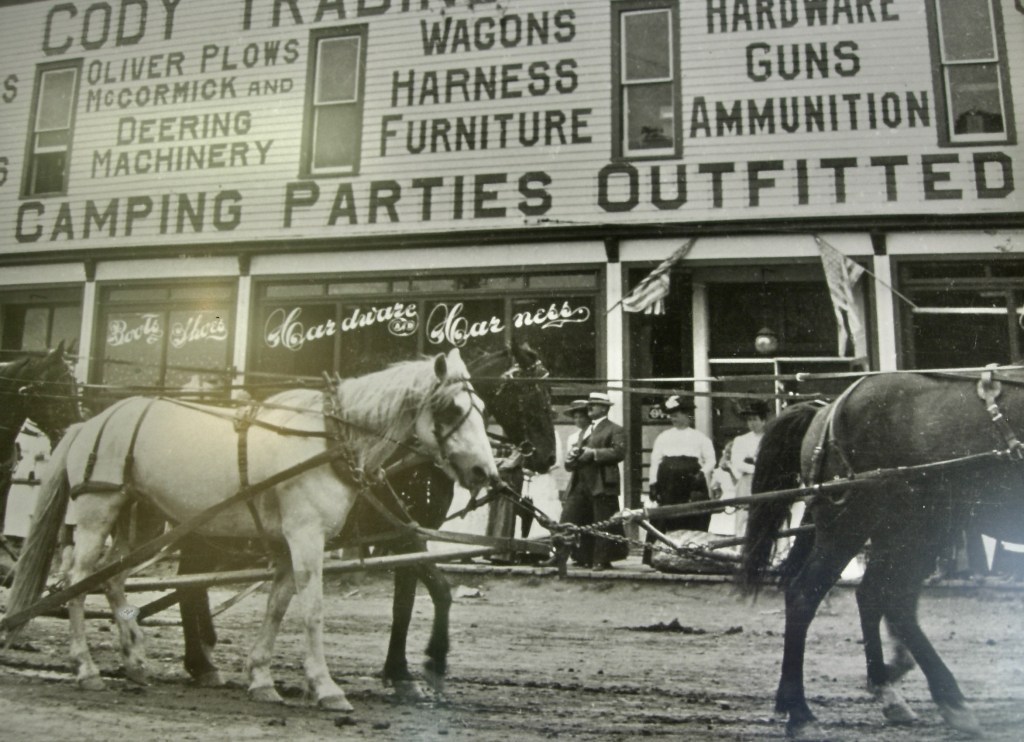
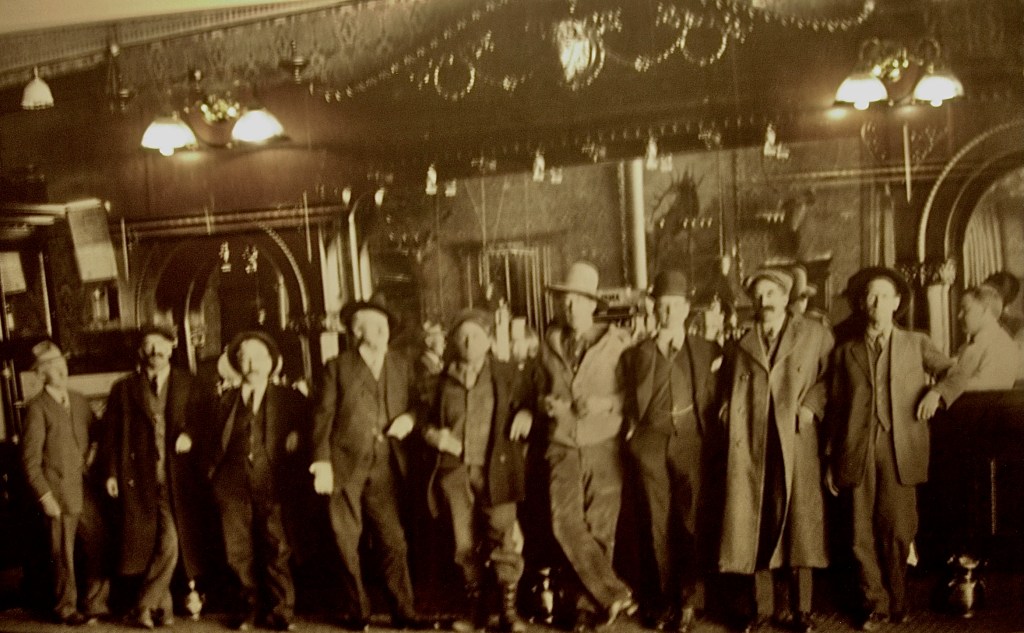


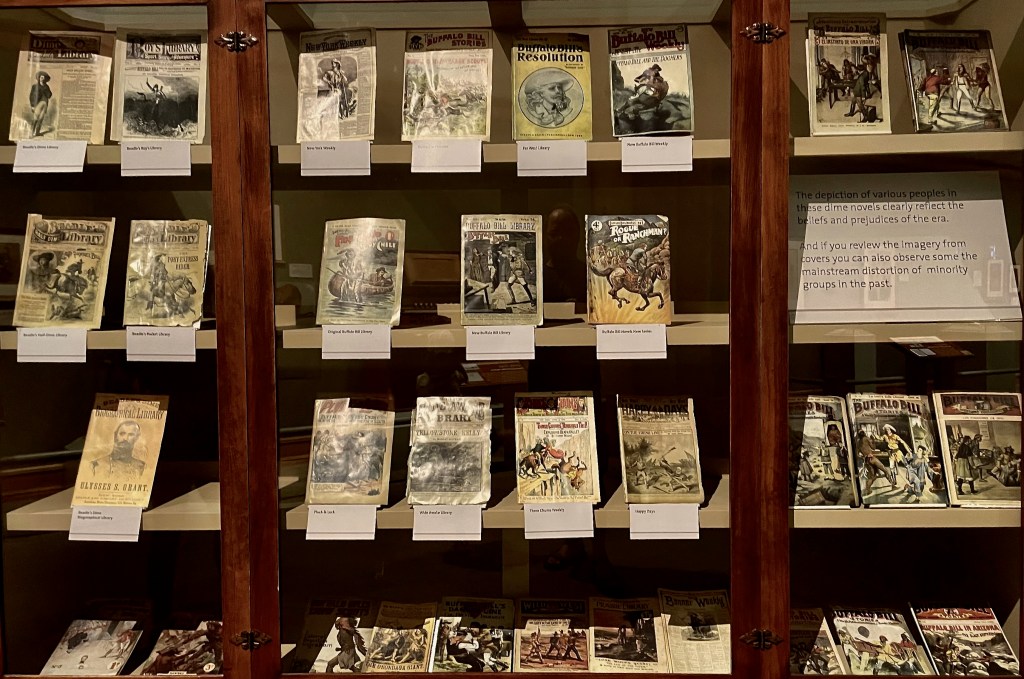


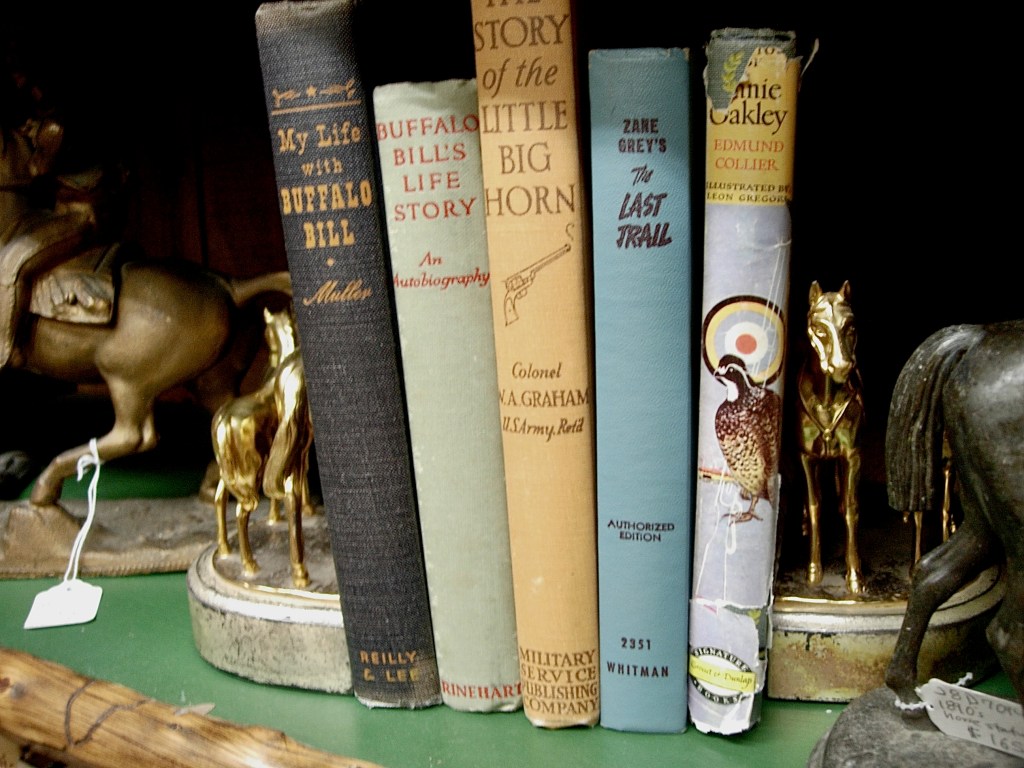

I hit it acutely when I returned to Cody. I knew far more, and I brought my dad. I’d flown through the blades of the windmills of the Irish Sea and Wyoming prairie to pick him up at his ranch, 12 miles from the ruts of the Denver to Deadwood Stage and 24 miles from the ruins of Fort Laramie where all the treaties were signed, then violated.
The grass didn’t care about the outcome, and the carnage and genocide hadn’t amounted to much progress: rough towns populated by walking wounded with oxygen tanks and mobility scooters, kept alive by disability benefits and an untenable future of fossil fuels, livened once a year by the ghouls of tattooed, bearded outlaw motorcyclists who swept in every summer on the way to Sturgis, the saloons primed with mechanical bulls and strippers, as poor and saggy as anywhere, privileged enough to stay alive. The grass didn’t judge; it insisted on growing, roots tapped twelve feet down into the dunes.
The prairie shone a bright, verdant green, brushed with color from spring’s wildflowers. The air sweetened with birdsong, calling, sounding, fighting, disputing, hunting, catching, twirling, diving, totally occupied in their business, then alighting, cackling, guarding, twittering and shrieking as the glorious wind kindled a tune in my ears.
“I put a padlock on my wallet,” dad said as we set out along the gravel road, larks leaping along with us.
The familiar ride changed dramatically north of Casper. Green hog backs with wind and water gaps, the grass waist high, the sun leading us to Montana. Then we slipped over the Bighorns at Dayton. They were shrouded in mist, and we gingerly picked our way down the peaks following a brilliant white river cutting into the red earth.
“Way too many trees,” dad remarked.
Cody’s steakhouse smelled captivating by the time we arrived.
Trucks gunned down the main drag and cowboy schlock spilled out from the giftshops. There wasn’t a sign of the town’s most famous son in leather breeches, high boots, tunic and hat, with his noble beard, for the place was devoted to the tourist dollar.
Once parked at the Sunset Motel, we unloaded the leftover sandwiches, Scotch and beer, wine and mineral water, and dad’s pills. The only thing to do was grab whatever was considered a meal.
I nursed a confused craft beer, waiting for my rainbow trout at the spot he chose, wishing I’d ordered chardonnay.
“Ever tell you about my owl Scuttlebutt?” he asked, tipping whisky over his ice.
Of course, he had but I shrugged no.
“Funny critter. Why, he was tied to a string and ate tinned horsemeat. If we forgot to feed him, he’d go after the dog’s tail. He wasn’t that mean and liked to chew on your finger. A good owl. Then Scuttlebutt was killed with a baseball bat by my neighbor for playing with his cats. You know he perched at night on the clothesline. He was a diurnal owl, not nocturnal at all. Slept like a log.”
“I thought Scuttlebutt was Ralph’s owl,” I said.
“Oh, never mind,” he replied, “I was just trying to be friendly and social.”
That night I questioned how well equipped I was for research into the sacred motherlode of American culture and history. I’d read most of the biographies, but I didn’t want to be cavalier either at this chance to access and research a primary source.
I picked up a badge for the McCracken Library at the historical center the next morning. I was allowed pen, paper, a computer and one idea.
Mary Robinson asked me to wear gloves as she led me underground to the archive.
“It’s good to be here,” I said.
She nodded, then said, “I’ve found some things you’re going to like.”
The reading room was a bunker lit with reverential baroque light, a trove of first editions and maps, manuscripts and dairies lining the shelves.
“They’re in these two stacks,” she said, patting the books and papers. “First, you’ll find Griffin’s account of his four years with the show in Europe. He highlights the time in Europe even if it doesn’t cover 1906. I’ve also dug up this souvenir Routebook from 1896 as that paints a nice picture of the workings of a tour. To be fair, we’re a bit stumped about this last European tour. Still, I did find this album of postcards. That might be something. You’ll need your gloves for that. I’ll leave you to it and you can browse and take notes. Diane will be here with you, too.”
I hadn’t noticed Diane breathing heavily in the corner as if she’s appeared from a trapdoor. I spread out the large format books on the oak table and arranged my space anyway.
Quickly I read about the start of the 1906 tour from the clippings, that the show wintered outside Marseilles in Camargue at the ranch of Marquis Folco de Baroncelli-Javon, near Arles, with gardians, that is, French cowboys, holding court.
But the album attracted me right away. Embossed with Secessionist gold script, it had been bleached by time from black to a soft regal purple.
“Turn the album’s pages from the outside,” Diane said. “I’d hate to see them ripped. They’re one of a kind.”
Admonished, I recognized the sizzling colors and printing techniques of these century-old European postcards common to today’s antique markets in Belgrade, Budapest or Bucharest, filed in shoe boxes according to place or action, the stand usually the domain of a grumpy collector who needed charming. I had questioned plenty of them about postcards of Indians or cowboys to little avail; very seldom did a vivid image surface for a rewarding bingo moment.
But I had little doubt they were out there, somewhere, traded as integral part of a show that generated huge amounts of money with merchandise, printed souvenirs, itinerates and surely photographs and that spent huge sums of money on press advertising and posters.
Inside was a jumble of townscapes from Genoa to Tarnopol, three dozen images overwhelmingly representing the 50-odd stands along the 1906 route in the Habsburg Empire. The first featured the house of a likeminded crusader, Christopher Columbus, the last mere shop fronts, with outlines of soldiers, pedestrians, peasants, busts of imminent men, and glimpses of everyday life collected at the stops in-between, streets calm and empty before the dawn of the motor age. Two characters regularly featured: Jews of Transylvania and Hungarian cowboys of the puszta.
Perhaps written in Bill’s soft, precise hand, one observation was addended to Kolomyja: “This is the town where they stole the tails of the WW [Wild West] horses.”
While gold for imagining contemporary life before the world wars, it was far from a personal account or film that captured the meetings and blendings that went on, and that was to be expected. I was trying to pinpoint interactions, conversations and exchanges that couldn’t be pinpointed, for which there was no record, and in the likelihood it had ever existed, then it had most likely been burned by Europe’s armies that torched Budapest, Kyiv, Moscow and Vienna. Yet those contacts were inspirational enough for Karl May to write his Shatterhand novels and in my mind mysteriously unlocked social taboos at the peak of Europe’s projects in the colonies expressed at home: cultural tropes that rejected Social Darwinism, where savages like Frankenstein, Dracula and Golem, or more plainly mystics, monsters and savants, who were tamed temporarily by the cowboys of invention with their guns, engines, electricity and light, who ultimately combined and established the rationale for what became the Holocaust.
Bill was a bad man indeed.
There was more to interpret, and I tried to maintain my serenity as I cradled the books, torn about which to crack.
First, my fingers needed to warm up as I prepared to transcribe the excerpts.
The performer Charles Eldridge Griffin spent four years overseas with the show and his account, originally published in 500 copies in 1908, is marked by humor and a deft appreciation of life in Europe. At age 44 the show brought him first to England. He doesn’t reveal much about his aliases: Monsieur Le Costro, Professor Griffin or the Yankee Yogi. As manager, he was expected to handle everything, as well as juggle, tell jokes, eat fire, hypnotize, swallow swords, do magic and create illusions when the show was live.
Idly throwing biscuits to the seagulls, Griffin waited on the Liverpool docks for the cowboys to arrive on the Etruria in March 1903. Most of them refused to disembark onto the harbor boats and stayed in their berths to recuperate from the seafaring: “All going out, nothing going in.”
Once safely on dry land and away from whales, icebergs and quoits on deck, they had entertaining to do, each day wooing European audiences with their acts of daring-do in a spectacle of the American frontier blended with the grotesques of the sideshow. They were hooked by physical wonder and a tight script that followed an emotional diet of drama (attack), catharsis (rescue) and pathos (losers), while off-stage sideshow freaks made sure everyone on the grounds got bang for the buck. Any money they had left was shelled out on items from a vast range of merchandise.
Over 300 days of performing and two seasons later, the show crossed to France, and Griffin had adjusted. While the show wintered for repairs in Stoke on Trent in 1904, he’d gallivanted for a month in Paris, so he had an inclination of what to expect when they pitched up on the Champs de Mars to play in a pavilion for 17,000 people, overlooked by le grand roué (Ferris wheel) nearby and a quantity of curious air balloons.
Cody was lionized with applause while Griffin entertained the crowds with his garbled French. With performers’ native languages ranging from Japanese to Lakota, Arabic to Russian, garbled language was a specialty and symbolic of the promise of the melting pot. In short, give up identity and culture for the nascent monsters of nationalism and global capitalism. The mechanism appeared quite innocent when backstage where the performers rubbed shoulders before joining the crowds to admire the luxury of Parisian arcades or wonder at the city’s illicit heart.
He remarked: “Being in such close contact every day, we were bound to get some idea of each other’s tongue, and all acquire a fair idea of English. Colonel Cody is, therefore, entitled to considerable credit for disseminating English, and thus preserving the entente cordial between nations.”
After nine weeks of sold-out Paris shows, the tour began in earnest with a stop in Chartres. Griffin was relieved: “Instead of the Eifel Tower, the big wheel, the huge Gallerie de Machines and the red sand of the Champ de Mars, we were greeted with growing grass, green tress and running streams.”
He was not alone in appreciating the fresh air. Edward Goodman, a cowboy son of North Platte perhaps enthralled by the tide of celebrity guests and hunting parties that had gravitated to Bill’s local home, Scout’s Rest, was attached to the show when it visited Switzerland. He wrote two letters from Interlocken to his relatives in August 1887:
“We are now at Interlocken, a fine city surrounded by mountains and two lakes, some of the highest of the Alps can be seen from here. We took a trip up one of the mountains close by which was 6,722 feet high and could see some of the most noted glaciers in Switzerland. We started 4.30 in the morning and did not get back until 6 in the evening. I walked all the day which was about 32 miles up and down the mountains. […] Do you not think I was quite a pedestrian? I did not realize I had walked so far until they told me. […]
“Today we took a drive up the valley of Lanterbrunnen where we saw two of the finest waterfalls in Switzerland; the Staubback and the Trummelback, the first was 1,000 feet high and a finer sight I never saw. We leave for Berne in the morning at 8.45 and from there to Mt. Blanc where we will have a fine time and be nearer the glaciers.”
Goodman’s passage recalls scenes from Frankenstein and Holmes, when evil lurks behind the sheets of crisp, alpine water, once upon a time when the Alps were distant and perilous.
Even the tame Béziers, midway between Montpellier and Perpignan, could be an occasion when the lens turned on Griffin:
“We occupied the military field, adjoining [what] was the bull ring, one of the largest and finest we had seen, built of red brick in circular form, with a seating capacity of 12,000. It is noticeable fact that we find at these bull rings the people seem to partake of the savagery they suggest. […] The audience tore up and set fire to the benches because the management refused to kill another bull, after already killing six, the advertised number. After a bull fight the carcasses are cut up and sold to the people for food. Is it any wonder that such people are savage?”
A few crucial recorded intersections along the French route indicate Europe’s bottomless appetite for the exotic and colonial as it clashed with American exceptionalism. What spectators didn’t realize was that they were being devoured themselves, absorbed by and primed for the mass culture juggernaut embodied by America’s Buffalo Bill. America was on the march, sending abroad its first branded international celebrity, its first cultural diplomat, to convince them of its semantics and its enemies.
In Lille, in 1905, they celebrated a Fourth of July devoted to Old Glory: “The entire encampment was gorgeously decorated in tri-colored bunting, a grand banquet was served to the members of the company, the bands played patriotic airs, and Colonel Cody gave one of his characteristic speeches, in which he eulogized the French nation for the important part they had played in American history.”
A year later, on the last European tour of 1906, they would celebrate again in Szeged, a southern Hungarian town famous for no more than salami, paprika and slippers – and the event that triggered my sleuthing – before crossing into Serbia and then turning northeast following the railroad, reaching new audiences and creating buzz.
Everyone who was anyone wanted to see what all the fuss was about.
On August 20, gala day in Vichy, the Shah of Persia and his entourage attended: “There were fully 17,000 people present, and when Colonel Cody shook hands with His Highness, the applause was tremendous. The Comtesse de Paris and party occupied a private box on the same occasion. If France was still a monarchy, she would probably be the reigning queen, as she is next in line of succession.”
And the performers returned the favor. When they returned to Paris on August 24, Griffin and friends visited the Exposition which featured live aboriginal and native exhibits from France’s colonies: “Among its most interesting features were Le Ville de Noir (the city of blacks), composed of ninety Senegalis….” Interestingly, what Griffin omitted was important: Buffalo Bill’s show also was an integral part of the Exposition’s official program of savages and delights.
Two of many messages can be decoded from Bill and his choreographed show: the Wild West achieved a cosmopolitan, preternatural mixing of cultures and peoples as a symbol of America’s creole cities, but lest we forget, at the expense of imperial ambition and extermination on a global scale that sought to erase difference and dark skin on any imperial frontier.
Within this traveling microcosm, a cycle of life and death: children were born to performers, some were thrown from their horses to their deaths, and some wandered off like the young shaman Black Elk in Paris. Griffin reserved the most words for the trauma of the glanders, a highly infectious and fatal bacteria that ravaged the stock, that culminated in Marseilles on the closing day of tour in November.
“Our magnificent draught stock […] never came in contact with the bronchos so they did not become contaminated. When the show was finally put away in Winter quarters, Mr. Bailey and Colonel Cody, equal owners of the Wild West, held a consultation and it was decided to kill the remaining hundred bronchos and burn all the trappings, that being the only way of stamping out the plague, and importing new bronchos and trappings from America the next season.”
The cull was kept quiet and out of view of the press.
My cosey time with Griffin was interrupted.
Mary Robinson materialized and became hostile about the amount I was copying. The book was out of copyright.
Unless they had designs on it themselves – which proved true as Four Years with Buffalo Bill was republished by their academic partners a few years later. As if I was dealing with the estates of Elvis or Marley, I had to move tenderly and not outstay my welcome.
Their stance didn’t matter, for I bid for a copy online and ponied up for the most I’d ever spent on a book yanked from the Warner Brothers Library. Such was the price attached to the mania and memorabilia associated with Buffalo Bill.
$600 for a torn pamphlet.
$8,000 for a musician’s cane.
A fortune for a saddle.
An 1896 Routebook that I was to handle next: priceless.
The endeavor was monumental and required flair, engineering and precision, borrowing techniques from military maneuvers, improving on them and later lending them to Hollywood, an illogical but apt mix of war and carnival.
Three trains were necessary for the magic to happen. One stabled 300 bronchos and numerous buffalo, elk, mules and oxen. Another cradled performers and crew. Another brought tents and accoutrements that needed to be unpacked nearly every day: 20 miles of rope to be unraveled, 13 miles of canvas to be unfurled and 1,100 stakes that needed driving into the ground.
They were all in it together. A choreographed routine of performers, roustabouts, barbers, tailors, smiths, cooks, bakers and ushers spilled from the wagons, each knowing their role and task, each wanting a hot meal and preferably hot water. Delays due to extreme weather, typhus, injuries, wounds and even death hardly stopped the show from going on, relentlessly presenting its American story of hearth and home.
Which didn’t always go to plan and required patience when it came to accommodating eccentric visitors. No one was too weird to be excluded from a Routebook:
“Marion: Indiana, 1887. […] We had quite a character in camp today in the person of Mrs. A Ryan Maxey, who was on horseback. She is known in different states by different nicknames. In Kansas it is Little Blue, in Missouri as the Woman in Blue, in Indian as True Blue. She is something of a writer and poet. Her makeup was certainly original, and I do not believe that any of us saw anything like it before. As is usual with such characters, she claimed close acquaintance with Col Wm F. Cody […].”
Every second had to count down as I tried to acquaint myself, too. I refocused on original voices exclusively recording the Eastern European tour and no one showed up.
What transpired over the next few days as the summer sun lured the traffic to Yellowstone was a personal reckoning. The historical record was virtually empty of such voices, at least at this institution, and recreating it required immersion and extrapolation since interviewing the main protagonists was impossible. Where were the accounts of the cast members like Standing Bear or Full Stomach who were unceremoniously repatriated to Pine Ridge reservation? And for that matter, strongman Salem Nasser or rider Hadj Ali, the female impersonator Harry St. Julian or Isadore Gonzalez, thrown to her death and unceremoniously buried in Bristol.
Trying to distinguish and interpret Cody and the show from the pageantry and legends became a miasma. Anything could be tossed into the managed chaos of the soup, only to emerge gleaming with import and meaning. I also twigged that bias and unhealthy fascination with death might explain my ideas. True, I couldn’t unabashedly endorse all this red-meat patriotism and I preferred to act like a good cowboy: a knight who rescues a stranded car from a ditch or rounds up lost cattle, the peacemaker who accepts that everyone has a place under the sun and is glad for the company, the diplomat who takes a knee and says sorry for the mess.
I needed a break, about two decades, to digest what I collected and pick up loose ends. I went to find my dad who’d visited the geysers in the park and browsed the guns in the two-day interim.
“They got Jeremy Johnson’s carbine right here,” he said. “He ate a lot of Indian livers, and I can’t believe they’ve put it out.”
He was looking restless, and we left for home in unstable weather, hail beating the magnificent pungent breath out of the sagebrush and into the truck. Between the tarnished green gold hills and the brooding gray lilac sky jagged tongues of lightening detonated, perhaps encouraged by the hydrogen sulfide leaking from the oil fields. We nosed south through the landscape, breathing, opening and closing around us, rises, bumps, knots, cuts, assemblages, ready-mades, as abstract as the trailer house crowds on the fringes of towns with names like Meeteetse and Ten Sleep, where my grandmother once had made camp as a young schoolteacher.
“Nice geomorphology,” dad observed, and I was left to ponder what it all meant when the rocks didn’t give a hoot about how the West was won either, just like the prairie. And like the moon, they would outlive us and our history. But maybe not the Bills.
- Transylvanian place names, due to a shared historical past, are presented in both Hungarian and Romanian. In deference to my Hungarian hosts at the time as well as the period under investigation (1906), I use Hungarian place names first. ↩︎
- Gehi Neanitu (2009) Ciobani Romani in Montana Statele Unite ale Americii, 1907–1913.
ISBN: 973 85211 3 0 ↩︎ - Later demand for utopia would be exhausted by western propaganda – following the footsteps of Bill’s cultural diplomacy – for there was no contesting the supply of communism. ↩︎
- Máramarosi lapok, Volume 21, No. 28. July 12, 1906, Printed by Sichermann Mor. ↩︎
- paper also included a cowboy and bucking bronco and stressed the international aspects of the show, including a reunion of Wild West and Wild East, than the particularly American aspects. There had been some concern during the tour about the profitability of the Italian leg and this pitch was a way that was found to appeal more to Italians or other audiences less familiar with Buffalo Bill and the show. ↩︎
- A riverside town 60 kilometers north of Budapest on the eastern bank of the Danube, opposite Vísegrád, which was the northernmost outpost of the Ottoman Empire. The town rests high up from the river’s course at the top of the topographical feature known as the Danube Bend. Zebegény features a compact church designed by the Transylvanian architect Káróly Kós. ↩︎
- James Fenimore Cooper’s five-volume series published from 1827–1841 about the Iroquois. Originally published in German in 1845, with over 70 mutations of the tales up to the 1980s, and in Hungarian in 1956. ↩︎
- Playing Indians was not among the three Ts – Támogatott, Tűrt, Tiltott – that guided the policies of György Aczél, the state censor. ↩︎
- Popular Hungarian folk singer (1943–2009) and leader of Hungarian Indians in the Bakony range, about 30 miles from Lake Balaton. ↩︎
 red hand agency